NMN, NAD+ and Sirtuins: What the 2026 Research Actually Says
NAD+ declines with age — can NMN reverse it? Mechanism, clinical evidence, NMN vs NR vs niacin, FDA status, and an honest cost-benefit analysis.

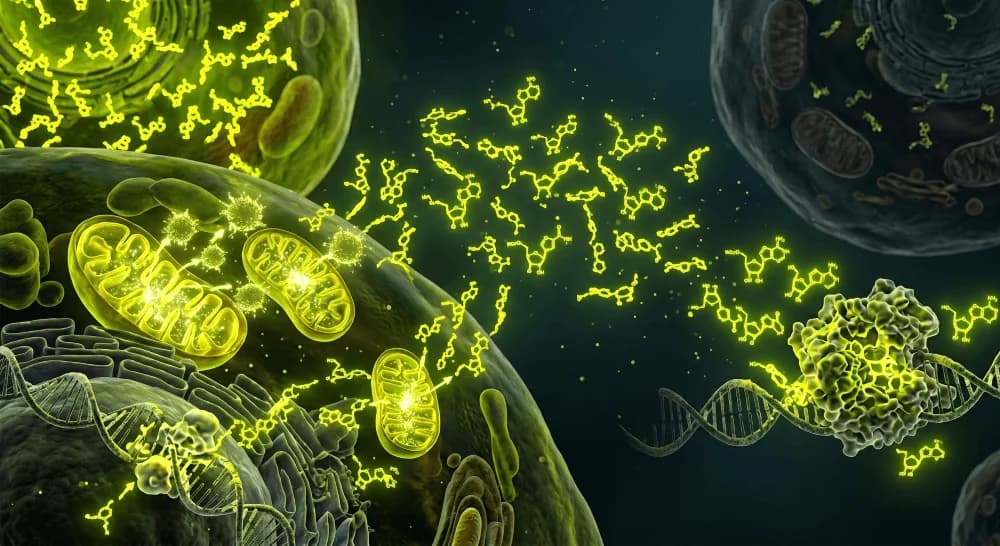
If one supplement has made more headlines in recent years than all others combined, it's NMN. David Sinclair on magazine covers, Joe Rogan debating dosages, Audrey-Hepburn-style promises floating through Instagram ads — the anti-aging pill.
The reality is more sober but still interesting: there are mechanistically strong arguments for NAD+ boosters, a growing number of human clinical trials, and at the same time major uncertainties about long-term effects, optimal form, and actual outcomes. This article breaks it down.
NAD+, NMN, NR — sort the terms cleanly first
Before the discussion: the central molecules in one table, because the terms get thrown around interchangeably.
| Molecule | What it is | Role |
|---|---|---|
| NAD+ | Nicotinamide adenine dinucleotide | The end product — central coenzyme used in the body. Cannot be supplemented directly (digested by the gut). |
| NMN | Nicotinamide mononucleotide | Direct precursor to NAD+, one enzymatic step away. Orally supplementable. |
| NR | Nicotinamide riboside | Indirect precursor — converts first to NMN, then to NAD+. Longer research history, FDA-GRAS status. |
| Niacin / nicotinamide | Vitamin B3 | Classical NAD+ precursor — cheap, well-researched, but high doses cause flush (niacin) or sirtuin inhibition (nicotinamide). |
| NMNH | Reduced form of NMN | Newer variant — 5× more potent in vitro, sparse in vivo data. |
Why NAD+? The three core roles in the body
NAD+ is not "a supplement" — it's a coenzyme in essentially every metabolic reaction. Three roles matter especially for longevity:
- Mitochondrial energy production. NAD+ is a cofactor in the citric acid cycle and the respiratory chain. No NAD+, no ATP production.
- DNA repair. The enzyme PARP1 consumes NAD+ at every DNA damage event. The more damage (age, UV, toxins), the more NAD+ gets drained.
- Sirtuin activation. The seven sirtuins (SIRT1–7) are NAD+-dependent deacetylases. They regulate gene expression, stress responses, insulin homeostasis. No NAD+ = no sirtuin activity.
The NAD+ decline
Studies consistently show: NAD+ drops measurably with age — in muscle, liver, skin, and brain by an estimated 30–50% between age 30 and 70. Mechanisms:
- Rising NAD+ consumption through chronically elevated PARP1 activity (more DNA damage)
- Increased consumption via CD38, an enzyme that grows with inflammaging
- Declining activity of the NAMPT enzyme that recycles NAD+
Niveaux de NAD⁺ au cours de la vie
Approximation basée sur des données transversales de tissus — le NAD⁺ diminue jusqu'à 65 % entre le début de l'âge adulte et 80 ans.
Massudi et al. 2012 · Camacho-Pereira et al. 2016
Sirtuins: The cellular emergency-switch family
Sirtuins are the main target molecules of the "NAD+ booster" hypothesis. What do they actually do?
| Sirtuin | Location | Main roles |
|---|---|---|
| SIRT1 | Nucleus / cytoplasm | Regulates insulin release, inflammation, autophagy. The most longevity-relevant sirtuin. |
| SIRT2 | Cytoplasm | Mitotic control, myelin metabolism |
| SIRT3 | Mitochondria | Mitochondrial antioxidant control, oxidative stress |
| SIRT4 | Mitochondria | Insulin release, amino acid metabolism |
| SIRT5 | Mitochondria | Urea cycle, detoxification |
| SIRT6 | Nucleus | DNA repair, telomere stability — extremely longevity-relevant |
| SIRT7 | Nucleolus | Ribosomal biogenesis |
David Sinclair frames it like this: when DNA damage occurs, sirtuins leave their posts as gene regulators and rush to repair. Over decades, not all of them return precisely — the epigenome blurs (see Aging as disease). Low NAD+ levels worsen the problem because the sirtuins "spark" less.
What the evidence shows — the key studies
Animal models
In mice the evidence is robust: NMN supplementation improves mitochondrial function, insulin sensitivity, endothelial function, bone density, and endurance (Mills et al. 2016, Cell Metabolism). In the mouse model NMN is practically a miracle pill. The problem: mice aren't humans, their NAD+ pharmacokinetics differ substantially.
Human studies
| Study | Setup | Finding |
|---|---|---|
| Yoshino et al. 2021 Science | 25 postmenopausal women, 250 mg NMN, 10 weeks | Muscle insulin sensitivity significantly improved. |
| Igarashi et al. 2022 NPJ Aging | 42 older men, 250 mg NMN, 12 weeks | Improved walking speed + grip strength (moderate). |
| Yi et al. 2023 GeroScience | 80 healthy adults, 300/600/900 mg, 60 days | Blood NAD+ dose-dependently raised. Few additional functional effects above 300 mg. |
| Liao et al. 2021 Front. Aging Neurosci. | Exercise study + NMN in seniors | Improved aerobic capacity in the NMN group. |
What's well-established: Oral NMN raises blood NAD+ levels dose-dependently. What's not well-established: Whether that translates into significant clinical outcomes (less disease, longer life, lower biological age) — studies are short, small, and largely industry-funded.
Most important caveat: Blood is not tissue. Higher plasma NAD+ doesn't guarantee that NAD+ rises proportionally in muscle, liver, or brain. Tissue NAD+ measurements require biopsies and are missing in most studies.
NMN vs NR vs niacin — which to pick?
This question is debated. Fact-based view:
| Aspect | NMN | NR | Niacin |
|---|---|---|---|
| Human clinical trials | ~10 phase I/II | ~30+ incl. phase III | Hundreds (for decades) |
| FDA status (US) | 2022 classified as drug — supplement marketing contested | GRAS (safe as food) | OTC vitamin |
| EU status | Not yet approved as Novel Food, gray area in Germany | Available | Free |
| Cost (300 mg/day) | €50–80 / month | €30–50 / month | < €5 / month |
| Flush effect | None | None | Yes for niacin (not nicotinamide) |
| Mechanistic strength | Direct precursor | Indirect precursor | Classical precursor |
My pragmatic take: If you want to run a NAD+ experiment and can afford it, take NMN (mechanistically more direct). If money matters, NR gets you almost as far. If you want "classical and cheap" longevity, low-dose niacin plus a generally good diet takes you far too.
Sublingual vs oral — hype or substance?
NMN is often sold as sublingual powder with claims of better bioavailability. The Yi 2023 study compared sublingual vs oral: the differences are small — the plasma NAD+ rise via oral isn't meaningfully smaller. Liposomal NMN sounds pricier, the extra benefit is marginal.
Dosage & timing
| Parameter | Recommendation |
|---|---|
| Starting dose | 250 mg/day |
| Studies' standard range | 250–500 mg/day |
| High-dose experiment | up to 1000 mg/day (Yi: no additional effect) |
| Timing | Morning — sirtuins are more active during daytime |
| With/without food | No clear data, with food tends to be better tolerated |
| Quality | Third-party tested (NSF, Informed Sport, COA per batch) |
Stacking with resveratrol & pterostilbene — the Sinclair classic
Sinclair argued NMN provides the fuel while resveratrol presses the pedal (via direct sirtuin activation). The theory is elegant — but clinical evidence for synergy in humans is thin. Pterostilbene (a resveratrol variant with better bioavailability) is often cited as a modern replacement.
Practically: Most documented study effects use NMN alone. If you want polyphenols, get them cheaper via olive oil, berries, and matcha (see Stack).
Cost-benefit reality check
A 300 mg/day NMN course costs about €60/month = €720/year. What does that buy you?
What you reliably get:
- Higher blood NAD+ levels (~30–50% rise)
- Plausible sirtuin activation
- With moderate probability, measurable improvements in insulin sensitivity
- Possibly marginal improvements in aerobic capacity / grip strength
What you do NOT reliably get:
- Longer life (no mortality data)
- Lower biological age on methylation clocks (mixed evidence)
- "Rejuvenation" like in mouse studies
For comparison: A gym membership (€300–600/year) plus 3× weekly strength training has an orders-of-magnitude better-documented effect size on healthspan, mortality, and biological age. If you can afford both: do both. If you must pick one: always the gym.
Compound details + current studies on NMN are also on the NMN compound page.
Common questions
Is NMN available and legal in Germany? Currently a regulatory gray area as a dietary supplement — not (yet) approved as Novel Food in the EU. Vendors in DE sell it, the risk formally sits with the importer. In the US, the FDA classified NMN as a "drug" in 2022, which complicates supplement marketing there.
Should I take NMN during a fast? Mechanistically plausible (sirtuins are more active in the fasted state). Not clinically established. If you're fasting anyway, you can try it — harm is unlikely.
What happens after stopping? NAD+ drops back to your individual baseline. There are no "rebound effects" or withdrawal symptoms.
Can I raise NAD+ naturally via lifestyle? Yes. The strongest levers:
- Intermittent fasting + caloric restriction — activates NAMPT, recycles NAD+
- Endurance training (Zone 2) — boosts mitochondrial NAD+ synthesis
- Sleep — NAD+/NAM ratio follows circadian rhythm
- Apigenin (in parsley) — inhibits CD38, which consumes NAD+
These four levers are free, well-documented, and logically come before any supplementation.
Which brands are reputable? Look for: HPLC purity ≥ 99%, COA per batch publicly accessible, third-party tested. Brands in the DE recommended range: Sunday Natural, Ascent Performance, NMN Bio. But careful: a high-priced label doesn't guarantee quality — third-party testing is the only reliable signal.
Conclusion — my honest take
NMN is mechanistically the most plausible of the "newer" longevity supplements. Research clearly shows it raises blood NAD+. What it does to your specific biography, mitochondria, and brain — we don't know exactly.
My ranking for someone starting out:
- Sleep · Exercise · Protein · Stress management — the free levers, all well-documented
- Basic supplements (vitamin D, omega-3, magnesium, creatine) — cheap, well-documented
- Intermittent fasting — free, very well documented for metabolic markers
- NMN (or NR) — once 1–3 are covered and budget allows
Anyone starting at step 4 mostly buys a good feeling. The real healthspan effect comes from 1–3.
- [1]Yoshino et al. (2021): Long-term NMN administration — Cell Metabolism
- [2]Yoshino et al. (2021): NMN raises insulin sensitivity in postmenopausal women — Science
- [3]Mills et al. (2016): Long-term NMN administration in mice — Cell Metabolism
- [4]Igarashi et al. (2022): NMN ergogenic effects in older men — NPJ Aging
- [5]Yi et al. (2023): Safety and efficacy of NMN in healthy middle-aged adults — GeroScience
- [6]Brakedal et al. (2022): Nicotinamide riboside (NR) in Parkinson — Cell Metabolism
- [7]Imai & Guarente (2014): NAD+ and sirtuins in aging — Trends in Cell Biology
- [8]FDA NDIN ruling on NMN (2022) — Chromadex statement
- [9]Sinclair Lab — Information Theory of Aging