Açaí
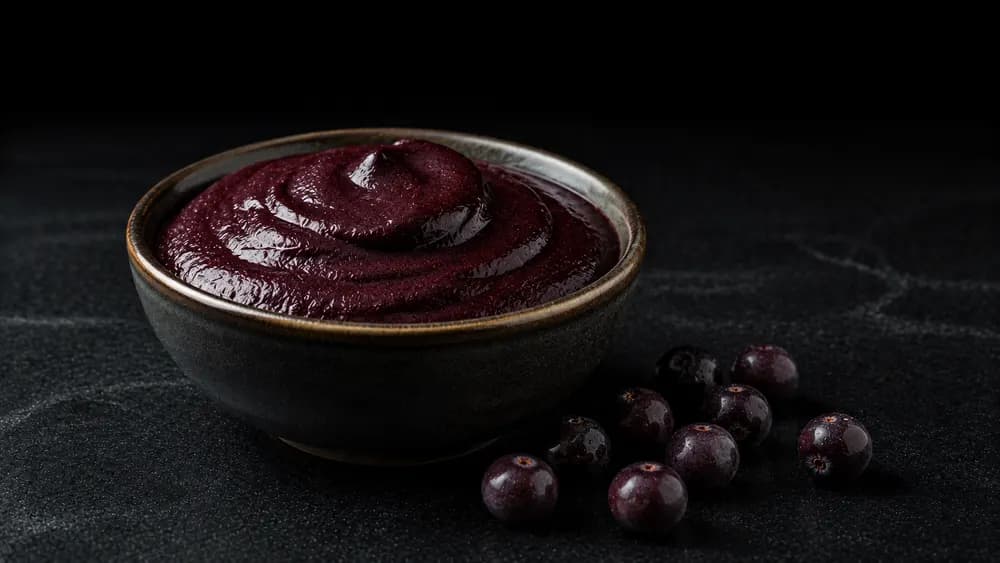
The berry that launched the superfood boom: fat- and anthocyanin-rich, with a high lab antioxidant capacity. The honest catch is the gap between marketing and human evidence — and that it's almost always sold as a sweetened bowl, while local dark berries do the same for a fraction of the cost.
Nutrition
Macros
Vitamins
Minerals
Dr. Gundry
In its pure, unsweetened form the açaí berry fits Gundry's yes-grid well: very low sugar, polyphenol-rich and unusually high in fat (mostly monounsaturated oleic acid, as in olive oil). The reason for the conditional isn't the berry itself but the product: açaí almost only reaches the shelf as sweetened purée, sorbet or a bowl with granola and honey — and thus as a sugar bomb Gundry clearly rejects. Anyone using the pure, unsweetened pulp stays on the recommended side.
Dr. William Li · 5×5 system
Li places açaí mainly under DNA protection because of its high anthocyanin density: the dark polyphenols provide a high antioxidant capacity. Unlike most berries, açaí is also fat-rich, which favours the uptake of the fat-soluble plant compounds. Fiber contributes moderately to the microbiome. The framing matters: the impressive antioxidant profile comes mostly from lab and test-tube measurements — the effect in the human body is less well documented than for blueberry or blackcurrant.
Biolazar evidence
Açaí is the teaching case for the difference between lab antioxidants and proven effect. In vitro the berry reaches very high ORAC values, and its anthocyanin and oleic-acid profile is genuinely good. But the human evidence is thin: only a few small studies (e.g. Udani on glucose and blood lipids), hardly any hard endpoints, some industry-linked. For the many circulating promises — detox, weight loss, anti-aging miracles — there is no solid basis. Two honest points: first, açaí is almost always sold sweetened (bowl, sorbet, juice), which cancels the low-sugar advantage. Second, local dark berries — blueberry, aronia, blackcurrant — do the same with better evidence and at a fraction of the price and carbon footprint. As unsweetened pulp a good berry, but no miracle.
How to use
Use only the unsweetened pulp or unsweetened frozen purée — watch for added sugar, syrup and honey in bowls and juices (the most common catch). Works as a base for a smoothie with other berries. For most people a local dark berry is the cheaper, equivalent and more sustainable choice; açaí stays a tasty variation, not a necessary superfood.
