Blueberries
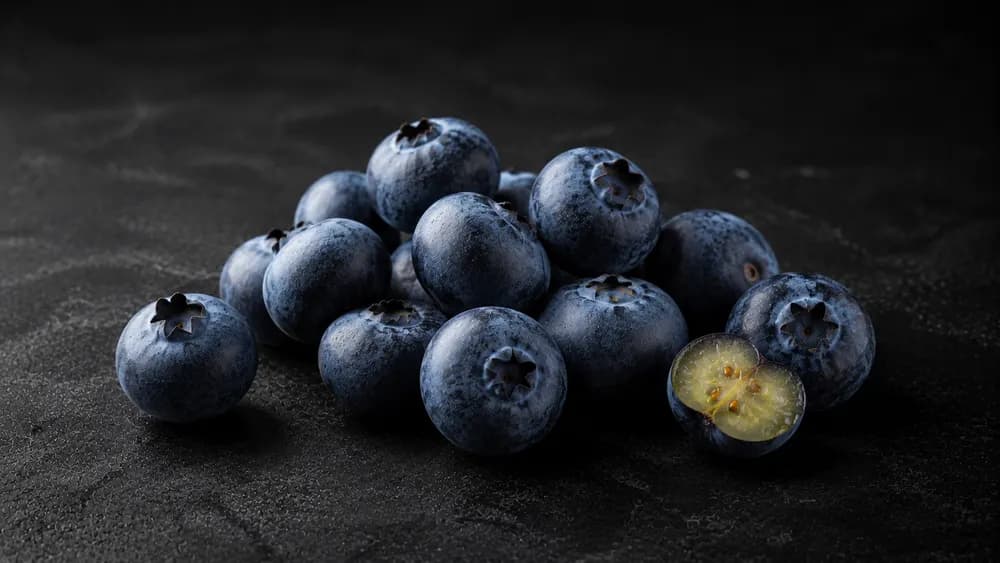
One of the most polyphenol-dense fruits there is. Anthocyanins carry consistent evidence for cognitive protection — and the low sugar load makes it the rare fruit even lectin-critics wave through.
Nutrition
Macros
Vitamins
Minerals
Dr. Gundry
Gundry limits fruit generally because of fructose but makes an explicit exception for berries — and blueberries sit high on his yes-list. His argument: the value is in the anthocyanins (the blue-violet polyphenols), not the sugar. He frames those polyphenols as anti-inflammatory, vessel-protective and food for a healthy microbiome, while fiber keeps the glycemic load low and the lectin content is minimal. His usual caveat: prefer dark, small (wild) blueberries, seasonal and unsweetened — the deeper the color, the higher the polyphenol density he actually means.
Dr. William Li · 5×5 system
Blueberries are among Li's most-cited foods and appear across several of his systems. Angiogenesis: anthocyanins and pterostilbene help keep vessel growth in balance and curb pathological tumour vascularisation. Regeneration: Li points to data in which berry polyphenols promote the mobilisation of circulating stem cells that repair vessels and tissue. DNA protection: the high antioxidant capacity buffers oxidative damage to the genome. Microbiome: most anthocyanins reach the colon and act there as a prebiotic. Wild blueberries (smaller, darker) carry a markedly higher anthocyanin density than cultivated ones — more active compound per gram.
Biolazar evidence
Unusually broad and strong evidence for a fruit — across several longevity axes. Cognition: the Nurses' Health Study shows up to ~2.5 years' delay in cognitive decline with regular berry intake in a large cohort; RCTs (Krikorian) improved memory in older adults with early memory problems. Cardiovascular: in the Cassidy cohort, high anthocyanin intake was associated with ~32 % lower heart-attack risk in younger women; RCTs show lower blood pressure and better vascular function, mechanistically via the NO pathway. Metabolism: smaller studies found improved insulin sensitivity. The active compound throughout is the anthocyanins, not the sugar. Framing: at ~10 g sugar/100 g, blueberries carry more than black- or raspberries — the whole berry (not sweetened products or juice) in a handful-sized portion keeps the balance clearly positive. Frozen berries retain almost all their anthocyanins.
How to use
A handful (about 80–150 g) daily, fresh or frozen. Prefer wild blueberries when available. Don't drown them in sugar — the value is in the anthocyanins, not as a dessert base.
Sources
- Devore et al. (Ann Neurol 2012): Beeren-Konsum und langsamerer kognitiver Verfall (Nurses' Health Study)
- Krikorian et al. (J Agric Food Chem 2010): Heidelbeer-Supplementierung verbessert Gedächtnis bei älteren Erwachsenen
- Cassidy et al. (Circulation 2013): Anthocyane und Herzinfarktrisiko bei Frauen
- Johnson et al. (J Acad Nutr Diet 2015): Heidelbeeren senken Blutdruck bei postmenopausalen Frauen — RCT
