Elderberry
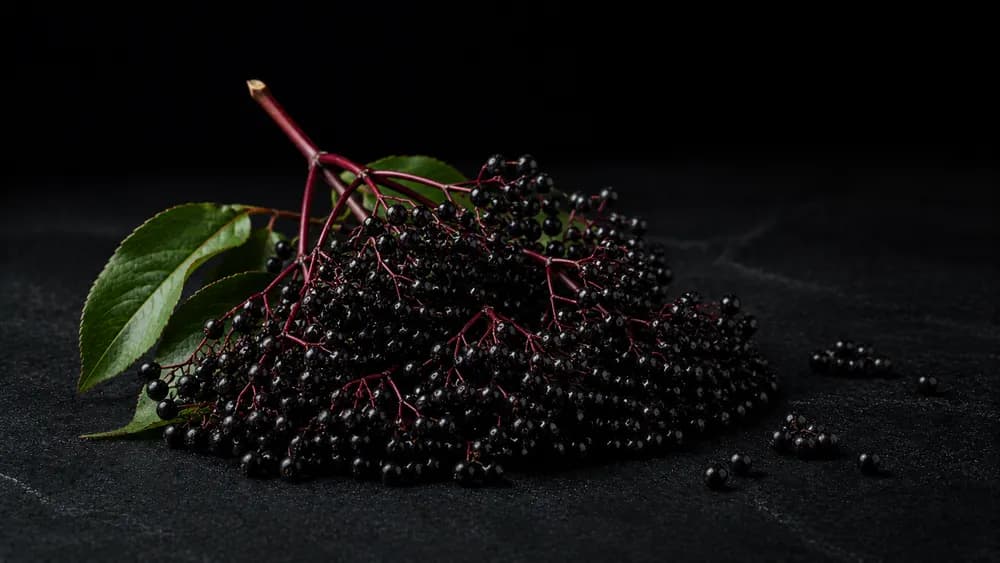
The classic immune berry: extremely anthocyanin-rich and the basis of countless cold syrups. A real core (small flu studies) but overhyped — and with an important safety point: raw elderberries are mildly toxic and must be cooked.
Nutrition
Macros
Vitamins
Minerals
Dr. Gundry
As a dark, low-sugar, anthocyanin-rich berry, elderberry fits Gundry's yes-thinking in principle. The conditional has two solid reasons: first, raw elderberries (and leaves, stems, unripe fruit) contain cyanogenic glycosides and a lectin — they are mildly toxic raw and must be heated, which fits Gundry's lectin caution. Second, elderberry is almost only sold as a heavily sweetened syrup, which he rejects. Prepared properly (cooked, unsweetened) it is a recommendable berry; raw or as a sugar syrup it is not.
Dr. William Li · 5×5 system
For Li, elderberry is clearly an immune and DNA-protection berry. Its exceptionally high anthocyanin content (elderberry is among the darkest berries) delivers strong antioxidant capacity, and the polyphenols are studied in connection with modulating the immune response to viral respiratory infections. Fiber (7 g/100 g) contributes to the microbiome. The immune-related effects are the best-studied part — for the other systems the data are thinner.
Biolazar evidence
The solid core: a few small RCTs and a meta-analysis (Hawkins 2019) suggest standardised elderberry extract may somewhat shorten the duration and severity of cold and flu symptoms — plausible via the anti-inflammatory, immune-modulating anthocyanins. But: the studies are small, heterogeneous and partly manufacturer-linked, and larger, independent confirmation is missing. There is no claim of preventing severe infection, let alone treating it; some experts even warned of an overshooting immune reaction in certain conditions. Two honest points: first, safety — raw elderberries are mildly toxic and must be cooked. Second, sugar — commercial elderberry juice and syrup are usually heavily sweetened, which cancels the berry advantage. Bottom line: a sensible, reasonably evidenced immune support in context, not a miracle.
How to use
Always use cooked — raw berries, leaves and stems are mildly toxic. Home-cooked, lightly or unsweetened elderberry purée or a standardised extract makes more sense than ready-made sugar syrup. As a course-based immune support in cold season, not a permanent product. Not a substitute for medical treatment of serious infections; with autoimmune conditions or immunosuppression, check with a doctor first.
