Currants (black & red)
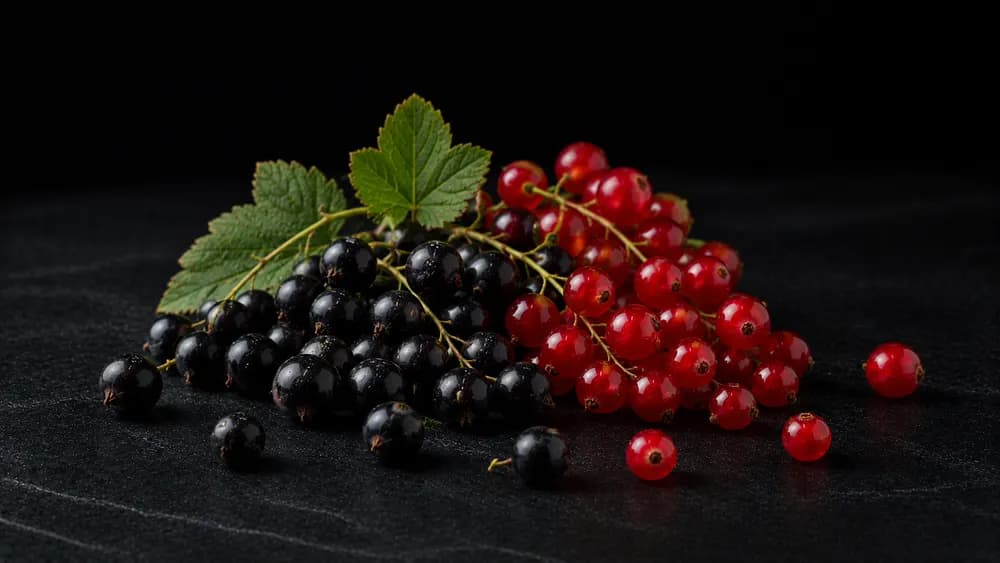
The underrated local powerhouse berry: blackcurrants deliver about three times an orange's vitamin C (~180 mg per 100 g) and are among the most anthocyanin-rich fruits — with real evidence for the eyes and blood flow. Redcurrants are milder but also very low in sugar.
Nutrition
Macros
Vitamins
Minerals
Dr. Gundry
Currants meet Gundry's criteria for recommended fruits to a T: low glycemic load, very high polyphenol density, few lectins. The deep color of the blackcurrant signals an especially high anthocyanin content — exactly the fraction he prizes in berries. His usual caveat applies practically here too: the fresh or purely pressed berry counts, not the heavily sweetened syrup or jelly currants often end up in because of their tartness.
Dr. William Li · 5×5 system
For Li, blackcurrants score on two fronts. DNA protection and immunity: the combination of exceptionally high vitamin C and a very high anthocyanin density delivers one of the strongest antioxidant and immune-supporting capacities among local fruits. Angiogenesis and blood flow: the same anthocyanins improve blood flow and oxygen delivery in studies — a reason blackcurrants are researched in endurance sport. The seeds also contain gamma-linolenic acid (GLA), a rare inflammation-modulating omega-6. Fiber contributes moderately to the microbiome.
Biolazar evidence
The solid core lies in the combination of two active compounds: the exceptionally high vitamin C (blackcurrant ~180 mg/100 g, about three times an orange) and the very high anthocyanin density. Cardiovascular: the general anthocyanin evidence (Cassidy cohort, lower heart-attack risk) applies here too. Blood flow/sport: several smaller RCTs from New Zealand show better peripheral blood flow and, in part, better endurance performance with blackcurrant extract. Eyes: the anthocyanins are studied for better dark adaptation and eye health — promising, but on smaller studies. Immune: the high vitamin C supports normal immune function. Framing: red and white currants have far less anthocyanin and vitamin C than the black — the blackcurrant is the real powerhouse. And the value sits in the whole berry, not the sweetened syrup.
How to use
Fresh in season (summer) or frozen — the nutrients are largely retained. Because of the tartness, blend with a little sweeter fruit rather than adding sugar. Prefer blackcurrants for maximum anthocyanin and vitamin C effect. As a topping, in smoothies or as unsweetened compote. Very vitamin-rich even in small amounts: a handful covers the daily vitamin C requirement.
