What is Longevity? Fundamentals, Hallmarks, and a 30-Day Start
Lifespan, healthspan, peak span — the twelve hallmarks of aging, what is actually modifiable, and a 30-day starter roadmap for longevity beginners.

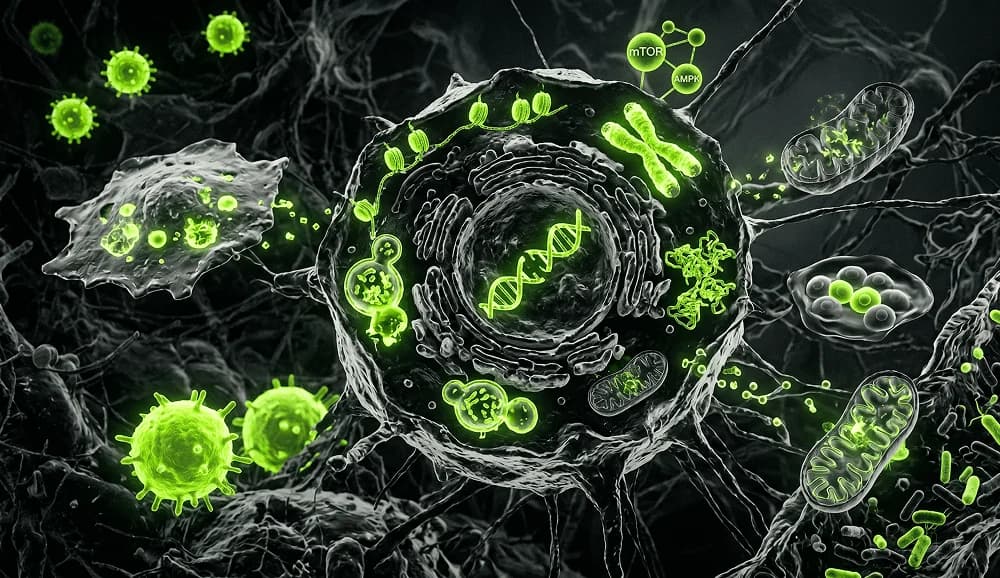
When someone asks what longevity actually is, the typical answer is reductive: "living longer". That's true — and also misleading. The interesting part of modern longevity research is not stretching the maximum human lifespan (biologically capped at ~115–120 years and barely moved for centuries). The interesting part is pushing the disease burden later — so the extra years aren't spent in a nursing home, but with full mental and physical capacity.
This article is the entry point: the three core concepts, the twelve scientific drivers of aging, which of them are modifiable, and which concrete first steps move the needle.
What does "longevity" mean?
Longevity (pronounced /lɒnˈdʒɛvɪti/) literally means a long life or long duration. In health and science, though, it means more than just living longer: it's the practice of maximising your healthy years — staying physically and mentally capable for as long as possible, not merely adding years. That distinction (lifespan vs. healthspan) is what we unpack first.
Lifespan, healthspan, peak span — the three concepts
| Concept | What it measures | Current state |
|---|---|---|
| Lifespan | Total years lived — birthday to death. | Germany avg.: ~81 years. Up ~10 years since 1970 — mostly via end-of-life medicine. |
| Healthspan | Years without chronic disease. | Germany avg.: ~70 years. Healthspan-lifespan gap = 11 years with disease. |
| Peak Span | Years at ≥ 90% of individual peak capacity. | Defined 2026 by Rhonda Patrick. Currently shortened by early insulin resistance and declining VO2max. |
The actual longevity goal is closing the gap between lifespan and healthspan — followed by extending peak span, the years where peak performance is still possible. More in the deep-dive Visceral fat, endocrine disruptors & Peak Span.
Scientific caveat: Olshansky et al. (2024, Nature Aging) argue convincingly that a radical lifespan extension beyond 90–100 years is unlikely — even with major medical advances. The realistic mission: more good years, not radically more years.
The twelve hallmarks of aging
López-Otín et al. first defined nine "hallmarks" in Cell in 2013 — biological mechanisms that measurably drive aging. In 2023 they expanded the model to twelve. This model is today's scientific consensus, the foundation of modern longevity research.
| # | Hallmark | What happens |
|---|---|---|
| 1 | Genomic instability | DNA damage accumulates, repair becomes inefficient. |
| 2 | Telomere attrition | Chromosome end-caps shorten with each division — senescence follows. |
| 3 | Epigenetic alterations | Methylation patterns shift, cells "forget" their identity. |
| 4 | Loss of proteostasis | Misfolded proteins accumulate (Alzheimer's, Parkinson's). |
| 5 | Deregulated nutrient sensing | mTOR, AMPK, sirtuins, insulin/IGF-1 fall out of balance. |
| 6 | Mitochondrial dysfunction | Cellular power plants become inefficient, ROS load rises. |
| 7 | Cellular senescence | "Zombie cells" won't stop emitting inflammatory signals. |
| 8 | Stem cell exhaustion | Tissue regeneration slows down. |
| 9 | Altered intercellular communication | Hormones, cytokines, neurotransmitters go chaotic. |
| 10 | Chronic inflammation (inflammaging) | Low-grade inflammation as a "dark fire" in the body. |
| 11 | Dysbiosis | Loss of healthy microbiome diversity. |
| 12 | Disabled macroautophagy | The cellular "waste disposal" slows. |
Three categories — how the hallmarks relate
López-Otín 2023 organizes the twelve into three groups — crucial for understanding where interventions act:
- Primary hallmarks (1–4 + 12) — causes of cellular damage. Yamanaka factors, partial reprogramming, spermidine (autophagy) act here. See Aging as disease.
- Antagonistic hallmarks (5–7) — stress responses. Helpful in moderation, harmful in excess. Rapamycin, senolytics, caloric restriction / fasting act here.
- Integrative hallmarks (8–11) — the systemic consequences. Exercise, sleep, microbiome care act here.
What's modifiable — and how?
The central good news: most hallmarks respond to lifestyle interventions. The strongest levers:
| Intervention | Hallmark effect | Evidence |
|---|---|---|
| Strength training 3×/week | Stem cell reactivation (8), insulin sensitivity (5), inflammaging (10) | Strong (meta-analyses) |
| Zone 2 cardio + HIIT | Mitochondria (6), cardiovascular function, inflammaging (10) | Strong — see Exercise & longevity |
| 7–9 h sleep | Glymphatic / proteostasis (4), inflammaging (10), insulin sensitivity (5) | Strong — see Sleep science |
| Intermittent fasting | Autophagy (12), mTOR reset (5), insulin (5) | Moderate — see Keto & insulin resistance |
| Mediterranean / plant-forward diet | Dysbiosis (11), inflammaging (10), mitochondria (6) | Strong (PREDIMED etc.) |
| Social connection | Inflammaging (10), stress hormones, cognitive reserve | Strong (Roseto / Blue Zones) |
| NMN / NR / sirtuin activators | NAD⁺ levels (5, 6) | Emerging — see NMN, NAD⁺ & sirtuins |
| Senolytics (fisetin, quercetin) | Cellular senescence (7) | Early-stage |
| Rapamycin (off-label) | mTOR inhibition (5), autophagy (12) | Early-stage, clinical trials ongoing |
Realistic framing: Lifestyle interventions have the strongest evidence and largest effect sizes. Pharmacological interventions (rapamycin, senolytics, exogenous NAD⁺ precursors) are interesting — but addition, not replacement, to the basics.
Measuring biological age — the epigenetic clocks
One of the most important insights of the past 15 years: calendar age (passport date) and biological age (cellular state) diverge. Some 60-year-olds have the biological age of a 50-year-old — and vice versa. Measured via DNA methylation patterns — so-called epigenetic clocks:
| Clock | What it measures | Use |
|---|---|---|
| Horvath clock (2013) | DNA methylation at 353 CpG sites — chronological age | Research standard, less practical |
| PhenoAge (Levine 2018) | Methylation + 9 biomarkers — mortality prediction | Better clinical signal |
| GrimAge | Methylation + plasma proteins + smoking history | Strongest correlation with mortality |
| DunedinPACE (Belsky 2022) | "Pace" of aging instead of absolute value | More sensitive to lifestyle interventions over short windows |
Commercially available via TruDiagnostic, Elysium, and select labs — price range €200–500 per test. Important: the tests are scientifically interesting, but the clinical actionability is (still) small. If your lifestyle stack is in order, measurement adds little marginal benefit.
Where to start? The 30-day starter roadmap
Starting from zero, do it in this order:
| Week | Focus | Concrete goal |
|---|---|---|
| 1 | Establish sleep | Fixed bedtime, 7–9 h, dark bedroom, no screens 1 h before sleep |
| 2 | Add movement | 3× per week strength training (full body), 2× 30 min Zone 2 |
| 3 | Tune nutrition | Last meal 3 h before bed, Mediterranean-leaning, a 14–16 h daily fasting window |
| 4 | Baseline labs + supplements | Standard panel + vitamin D, omega-3 index, possibly HOMA-IR. Supplements only after labs. |
These four weeks alone produce a larger healthspan effect than any pill on the market. Only once that base is solid does it make sense to layer in NMN, spermidine, senolytics & co.
Common questions
Is aging a disease? Scientifically contested. In 2018 the WHO added an aging-related code (XT9T) to ICD-11 and withdrew it after criticism. Practically, aging is the most important risk factor for the leading causes of death (cardiovascular, cancer, dementia). Treating the aging process itself instead of individual end-diseases is the concept of geroscience — see Aging as disease.
Can I measure my biological age? Yes, via epigenetic clocks (above). But: measurement doesn't substitute for action. Someone who trains zero hours and sleeps 5 h knows their biological state without a test.
Which supplements are worth it first? The basics (vitamin D, omega-3, magnesium) cover deficiencies that actually exist in most people. Creatine as a universal performance booster (muscle + brain). Everything else — NMN, spermidine, senolytics — comes after the basics, not before. Current state in the Stack.
How much money do I need to invest? The biggest levers are free or cheap: sleep, exercise, nutrition. A reasonable supplement setup runs €30–80 per month. Epigenetic tests are nice-to-have, not required.
Where do I start? With the 30-day roadmap above. Sleep first, because sleep amplifies all other interventions. Then strength training, then nutrition, then supplements.
Conclusion
Longevity is not a hype trend and not a miracle pill. It's the sober application of two decades of geroscience research to everyday life. The hallmarks show where aging happens. The interventions show what we can do about it. The roadmap shows where to start.
The rest is consistency over years — not weeks.
- [1]López-Otín et al. (2023): Hallmarks of Aging — an expanding universe — Cell
- [2]López-Otín et al. (2013): The Hallmarks of Aging — Cell (original paper)
- [3]Horvath (2013): DNA methylation age of human tissues and cell types — Genome Biology
- [4]Levine et al. (2018): PhenoAge — Aging (Albany NY)
- [5]Belsky et al. (2022): DunedinPACE — eLife
- [6]Olshansky et al. (2024): Implausibility of radical life extension — Nature Aging
- [7]WHO ICD-11 — aging-related code (XT9T) controversy
- [8]Sinclair Lab — Information Theory of Aging