Bone Marrow & Longevity: Adiponectin, Glycine, and Cellular Renewal
Why bone marrow is back as a longevity superfood — what the evidence actually shows on adiponectin, CLA, glycine, and vitamin K2, and where biohacking hype outruns the data.

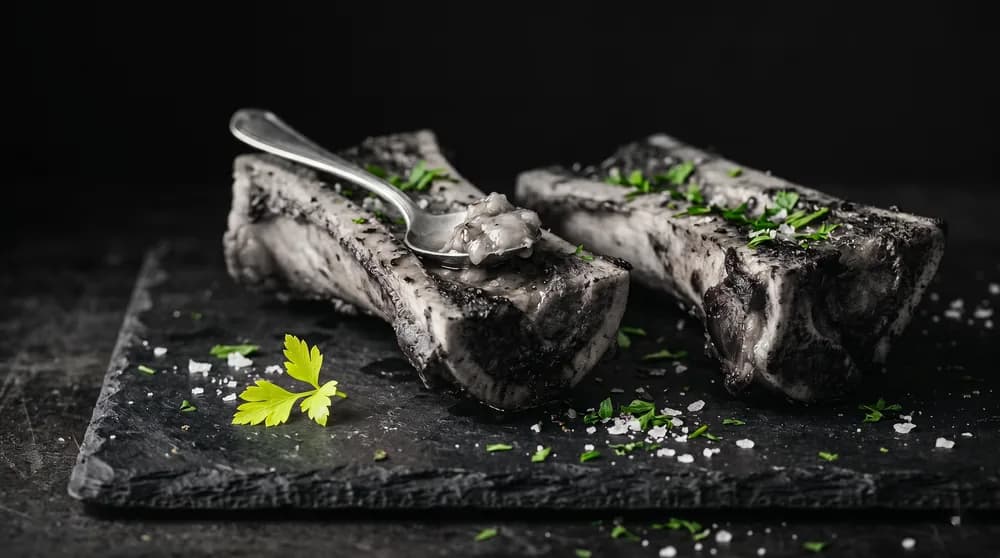
In evidence-based nutrition and the biohacking world, one archaic food is making a comeback: bone marrow. We almost exclusively eat lean muscle today, but our ancestors went systematically for the large long bones — probably because that's where the highest energy density and an unusual spectrum of bioactive lipids sit.
From a longevity angle, bone marrow is interesting because it isn't passive fat tissue. It's an endocrine-active organ with its own adiponectin signal — plus a collagen matrix, glycine, fat-soluble vitamins, and conjugated linoleic acid. Compelling mechanism, thin human data — most evidence comes from animal and cell models or from research on endogenous marrow, not the eaten kind.
Here's an honest take on what's established, where it gets speculative, and what a reasonable protocol looks like.
The evidence at a glance
| Mechanism | Evidence | Take |
|---|---|---|
| Marrow adipose tissue (MAT) secretes adiponectin; expands under caloric restriction | 🟡 moderate | Cawthorn 2014 shows it for endogenous MAT — not for eating bone marrow |
| Glycine as glutathione precursor & metabolic anti-inflammatory | 🟢 strong | Established biochemistry + RCTs on glycine supplementation |
| Grass-fed CLA dampens inflammation markers | 🟡 moderate | Mixed studies; dose-dependent |
| Collagen/glycine reinforces intestinal tight junctions | 🟠 emerging | Mechanistically plausible; clinical data thin |
| Marrow K2 as cardiovascular protection | 🟠 emerging | Marrow contains K2 — natto, hard cheese, egg yolk are denser sources |
| "Bone marrow = the animal's most valuable tissue" | 🔴 overstated | Liver beats marrow on micronutrient density by a wide margin |
So bone marrow isn't a magic anti-aging elixir — but it is an unusually nutrient-dense whole food with a realistic place in an honest longevity protocol.
1 · The adiponectin paradox: marrow fat as an endocrine organ
The edible portion of long bones is mostly yellow marrow — scientifically Marrow Adipose Tissue (MAT). For a long time it was treated as passive energy storage. The Cawthorn group showed the opposite in 2014: MAT is endocrine-active and releases meaningful amounts of adiponectin into circulation (Cawthorn et al. 2014).
Adiponectin is a key metabolic-health hormone:
- improves insulin sensitivity in muscle, liver and adipose tissue,
- promotes fatty-acid oxidation in mitochondria,
- is anti-atherogenic and cardioprotective,
- typically drops in obesity and rises during weight loss.
The paradox
While ordinary visceral fat shrinks under caloric restriction, MAT paradoxically expands — and contributes a substantial share of the systemic adiponectin rise during fasting. That links two seemingly opposite worlds: nutrient-dense eating and caloric restriction.
Important: This effect is documented for the body's own marrow fat — not necessarily for eating bone marrow triggering the same signal. What realistically arrives via the gut are the lipids, fat-soluble vitamins, and structural proteins dissolved in marrow. The endogenous adiponectin mechanism is an interesting context, not a direct effect of the meal.
2 · Targeting inflammaging: CLA + glycine
A central driver of aging is inflammaging — chronic low-grade inflammation that degrades tissues over decades (Franceschi & Campisi 2014). Bone marrow brings two antagonists:
Conjugated linoleic acid (CLA)
Marrow from grass-fed beef is a relevant CLA source. CLA can dampen expression of pro-inflammatory cytokines like TNF-α and shifts lipid-metabolism pathways (den Hartigh 2019). Important framing: the highest CLA concentrations are in grass-fed dairy fat (butter, hard cheese). Bone marrow is a complementary source, not a monopoly.
Glycine
Bone marrow sits inside a collagen matrix that partially breaks down to gelatin when heated. That delivers meaningful amounts of glycine — an amino acid with three longevity-relevant roles:
- Precursor to glutathione, the body's master antioxidant,
- Anti-inflammatory in macrophages (dampens NF-κB signaling in animal models),
- Methionine antagonist — a lower methionine/glycine ratio correlates with extended lifespan in rodent models.
More on the mechanics: glycine and collagen compound profiles. For the methylation angle: MTHFR/COMT & nutrient deficiencies.
3 · Barrier integrity: gut, joint, vessel
Biological barriers grow more permeable with age. In the gut this is increased intestinal permeability ("leaky gut"). When lipopolysaccharides (endotoxins from bacterial cell walls) leak into circulation, they feed systemic inflammaging. Bone marrow contributes structural raw material:
| Compound | Function | Longevity link |
|---|---|---|
| Collagen → gelatin → glycine/proline | Building blocks for intestinal tight-junction proteins | Signal toward reduced permeability (preclinical) |
| Glycosaminoglycans (hyaluronic acid, chondroitin) | Extracellular matrix | Cartilage + vascular integrity |
| Lipids + fat-soluble vitamins | Membrane repair | Cell-membrane fluidity & signaling |
Context: The mechanism is plausible and well supported in cell and animal models. Solid RCTs in humans using bone marrow as the intervention don't exist — the evidence base sits in collagen-peptide and glycine trials. That doesn't make it worthless; it just means we frame it honestly.
4 · The fat-soluble nutrient matrix
Bone marrow carries fat-soluble vitamins (A, E, K2) and is a good source of bioavailable lipids — saturated and monounsaturated fatty acids that carry the vitamins. This is the "food matrix" idea: in nature, micronutrients almost never act in isolation.
- Vitamin K2 (menaquinone): Cofactor for matrix Gla-protein, which redirects calcium from vessel walls back into bone matrix. Marrow delivers some K2 — but the denser sources are natto, hard cheese, egg yolk and liver (Schwalfenberg 2017). Marrow complements but doesn't replace a focused K2 profile. To optimize: Vitamin D3 + K2.
- Omega-3 profile: Only grass-fed delivers a favorable omega-3 to omega-6 ratio (Daley et al. 2010). Feedlot beef adds little here. Add insurance via omega-3 fish oil.
5 · The practical protocol
| Parameter | Recommendation | Why |
|---|---|---|
| Quality | 100 % grass-fed / organic beef | Better omega-3:6, more CLA, fewer heavy metals |
| Amount | 1–2 servings per week, 1–2 marrow bones each | Energy-dense (~700 kcal/100 g) — not daily |
| Preparation | 180 °C oven, 15–20 min, soft but not fully melted | Preserves collagen, avoids oxidized fats |
| Pairing | Acidic (sauerkraut, lemon) + bitter herbs | Stimulates bile, improves fat digestion |
| Context | Keto / low-carb / carnivore-light | Matches the fat load; less useful as a side to high-carb |
Practical tip: If marrow bones are hard to find or the flavor is too strong, bone broth (6–24 h simmer) and hydrolyzed collagen peptides are everyday-friendly alternatives for the glycine/collagen portion — without invoking the adiponectin myth.
6 · Overrated: where the bone marrow hype outruns the evidence
Caveat: Bone marrow is nutrient-dense — but the specific longevity claims online routinely overshoot.
- "Stem-cell booster": No solid human studies show that eating bone marrow activates hematopoietic stem cells. The claim conflates the tissue with its in-vivo function.
- "Richest CLA source": Wrong — that's grass-fed dairy fat.
- "Near 100 % absorption" of fat-soluble vitamins: Overstated. The lipid matrix improves bioavailability substantially, but it doesn't reach 100 %.
- Marrow capsules (beef marrow glandulars): Capsules rarely deliver therapeutic doses of the relevant bioactives. Whole food > powdered surrogate.
- "Most valuable tissue of the animal": On micronutrient density, marrow loses to liver (retinol, B12, choline, folate) — see nutrient density: animal vs. plant.
7 · Important caveats
- Cholesterol / LDL hyper-responders: Marrow is very fat- and cholesterol-rich. If you're in the 15–25 % hyper-responder group, monitor your ApoB — see the biomarker guide.
- Heavy metals (lead, cadmium) in bone tissue: Animals store heavy metals in the bone matrix. With long-term consumption of bone broth/marrow from conventional sources, switch to certified organic/grass-fed — EFSA has clear assessment criteria for lead intake (EFSA 2010).
- Caloric reality: ~700 kcal per 100 g of marrow. Fine inside a hypercaloric bulk; use deliberately inside a calorie deficit.
- Gout / uric acid: Marrow itself is low in purines — but broth from entire skeletons can be higher. If you have a gout diagnosis, run it past a clinician.
Bottom line
Bone marrow isn't a magic longevity bullet — and not the universal stem-cell trigger some biohackers market it as. It is a high-quality, nutrient-dense whole food with a defensible spot in a nose-to-tail strategy:
- Delivers bioavailable glycine, collagen, fat-soluble vitamins and (from grass-fed) CLA + a favorable omega profile.
- Connects mechanistically to inflammaging reduction and barrier integrity — well supported in preclinical models.
- The adiponectin story is real but applies primarily to endogenous marrow fat under fasting, not 1:1 to eating it.
- Source matters: 100 % grass-fed / organic only, 1–2× per week, inside a fat-adapted diet.
Framed honestly: bone marrow is a solid nutrient-density booster, not an anti-aging hack. That's exactly how it belongs in the protocol.
- [1]Cawthorn et al. (2014): Bone marrow adipose tissue is an endocrine organ that contributes to increased circulating adiponectin during caloric restriction (Cell Metabolism)
- [2]Scheller et al. (2016): Region-specific variation in the properties of skeletal adipocytes (Nature Communications)
- [3]den Hartigh (2019): Conjugated Linoleic Acid Effects on Cancer, Obesity, and Atherosclerosis — A Review (Nutrients)
- [4]McCarty & DiNicolantonio (2014): The cardiometabolic benefits of glycine: is glycine an 'antidote' to dietary fructose? (Open Heart)
- [5]Razak et al. (2017): Multifarious beneficial effect of nonessential amino acid, glycine: A review (Oxidative Medicine and Cellular Longevity)
- [6]Schwalfenberg (2017): Vitamins K1 and K2 — The Emerging Group of Vitamins Required for Human Health (J Nutr Metab)
- [7]Franceschi & Campisi (2014): Chronic inflammation (inflammaging) and age-associated diseases (J Gerontol A Biol Sci Med Sci)
- [8]Daley et al. (2010): A review of fatty acid profiles and antioxidant content in grass-fed and grain-fed beef (Nutrition Journal)
- [9]EFSA CONTAM Panel (2010): Scientific Opinion on Lead in Food (EFSA Journal)