Acacia Fiber: The Gentle Prebiotic for Your Gut
Acacia fiber (gum arabic) as a soluble fiber: what's really proven for the microbiome, blood sugar and weight — and why it's better tolerated than many other prebiotics.

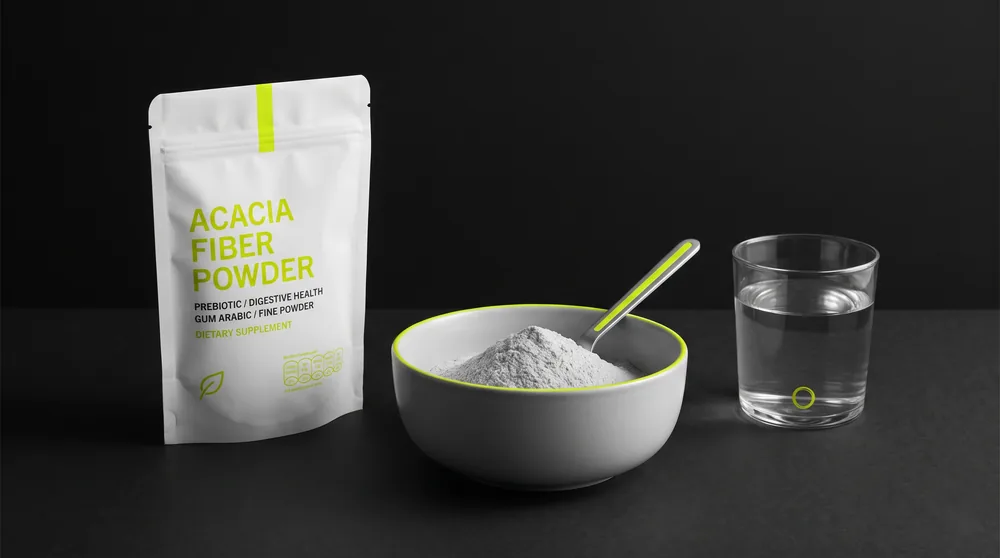
In functional nutrition, a centuries-old natural product is coming back into focus: acacia fiber — often sold as gum arabic, harvested from the dried resin of the acacia tree. The food industry has long used it as an emulsifier and thickener. As a supplement it's something else: a water-soluble, fermentable fiber that feeds the gut microbiome.
What's proven — and what's marketing? The honest short version: the prebiotic effect and the good tolerability are solid; for weight, cholesterol and "healing promises," a sober look pays off.
Claim vs. evidence at a glance
| Claim | What the evidence shows | Verdict |
|---|---|---|
| Prebiotic: boosts bifidobacteria, forms SCFAs | Controlled human studies, dose-dependent bifidogenic | 🟢 supported |
| Especially well tolerated (little bloating) | Slow fermentation → less gas than inulin/FOS | 🟢 supported |
| Eases IBS symptoms | Small studies, promising | 🟡 preliminary |
| Lowers blood-sugar spikes | Plausible (soluble gel fiber) | 🟡 plausible |
| Helps with weight loss (BMI/body fat) | One small RCT, moderate effects | 🟡 weak |
| Lowers LDL cholesterol "by 15%" | Evidence mixed, magnitude uncertain | 🟠 overstated |
| Hemostasis, wound healing, gums | Traditional use, little controlled data | 🟠 traditional |
What acacia fiber is
Acacia fiber is the dried tree resin (exudate) of various Acacia species, mainly from Africa's Sahel. It is taste-neutral, dissolves clear in water, barely gels — and is classed as GRAS (generally recognized as safe) by the U.S. FDA. Unlike insoluble bran, it's a soluble, fully fermentable fiber.
The prebiotic: food for the microbiome
This is where the evidence is strongest. Acacia fiber isn't broken down in the small intestine but fermented in the colon by the microbiome. Controlled human studies show a dose-dependent bifidogenic effect — it specifically increases beneficial bifidobacteria (Calame 2008).
Fermentation produces short-chain fatty acids (SCFAs) like butyrate:
- They are the main energy source of the colon lining and act broadly anti-inflammatory.
- They support the tight junctions (the gut wall's cell connections) — relevant for barrier integrity (SCFA & gut barrier).
The real advantage: acacia fiber is fermented slowly. That means markedly less bloating and gas than fast-fermenting prebiotics like inulin or FOS. That's exactly what makes it attractive for sensitive guts — including IBS, where small studies suggest symptom relief.
To support the microbiome more broadly, it pairs well with other fibers like inulin and with probiotics — diversity beats monoculture.
Metabolism: blood sugar, satiety, weight
Blood sugar: as a soluble gel fiber, acacia slows glucose uptake and can flatten post-meal spikes — the same mechanism as other viscous fibers. The mechanics are in the glycemic pillar.
Satiety: the SCFAs formed during fermentation are linked to satiety signals (via gut hormones and the brain's appetite center). Mechanistically plausible, but not an "appetite suppressant."
Weight — framed honestly: the much-cited study is one small RCT (Babiker 2012, Nutrition Journal): 120 healthy women, 30 g/day for 6 weeks vs. placebo. Result: BMI down by ~0.3 points and body fat by ~2.2 percentage points. A real but moderate effect from one small study in women — not a weight-loss miracle. (Note: some texts wrongly turn this into "2% BMI reduction" or two separate studies — it's the same paper, and the ~2% refers to body fat.)
Cardiovascular: cholesterol
Soluble fibers can bind bile acids, prompting the liver to pull cholesterol from the blood to replace them — the familiar LDL-lowering mechanism (strongly proven e.g. for oat beta-glucan). For gum arabic specifically the evidence is mixed: some studies show a modest LDL reduction, others no clear effect. The popular "minus 15%" figure isn't reliably established — expect at best a small extra contribution, not a statin replacement.
Traditional topical uses
Folk medicine also uses acacia topically — but these uses are barely studied in controlled trials:
- Gums/plaque: chewing the resin is said to reduce plaque and gingivitis (small hints).
- Throat: as a demulcent (mucosa-soothing) tea for dry cough.
- Hemostasis: traditionally applied to small wounds — weak evidence.
These are nice extras, but not the reason to take acacia fiber — the gut is.
Use, dosing & safety
- Intake: taste-neutral, dissolves in water, a smoothie or food. A tablespoon covers roughly a quarter to a third of daily fiber needs.
- Dosing: ramp up slowly — start with ~1 tsp/day, build over days/weeks to 1 tbsp (or up to ~30 g as in studies). Drink enough water.
- Safety: GRAS, very well tolerated, allergies rare. Caveat: fiber can delay drug absorption — space doses 1–2 h apart. Pregnant/breastfeeding people and anyone on critical long-term medication: check with a doctor first.
Xanthan aside: often confused — xanthan (from bacterial sugar fermentation by Xanthomonas) is an extremely strong binder used in tiny amounts (keto baking). Acacia fiber, by contrast, is taken in large amounts as a fiber supplement. Different role, different product.
Bottom line
Acacia fiber is no miracle cure, but a solid, gentle prebiotic: well-documented bifidogenic, SCFA-forming, and above all exceptionally well tolerated — ideal for sensitive guts and as an on-ramp to more fiber. Plausibly supportive for blood sugar and satiety; moderate for weight (one small RCT); thin for cholesterol and the traditional topical uses.
Net: an inexpensive, well-tolerated building block for gut health — best as part of a fiber-diverse, plant-forward diet, not as a standalone remedy.
- [1]Babiker et al. (2012): Effects of gum Arabic ingestion on BMI and body fat percentage in healthy adult females — RCT, Nutrition Journal (PMID 23241359)
- [2]Calame et al. (2008): Gum arabic establishes prebiotic functionality in healthy humans (dose-dependent bifidogenic) — British Journal of Nutrition
- [3]PubMed search: Short-chain fatty acids (SCFA) & intestinal barrier / tight junctions
- [4]PubMed search: Acacia fiber / gum arabic in irritable bowel syndrome (IBS)
- [5]PubMed search: Gum arabic & blood lipids / LDL cholesterol (mixed evidence)
- [6]U.S. FDA: Gum arabic (acacia) — status as a GRAS food additive