Smoothies & Longevity: Elixir of Life or Sugar Trap?
Are smoothies healthy or a hidden sugar trap? What blending does to blood sugar, the food matrix and free sugars — and how a green smoothie becomes a real longevity tool.

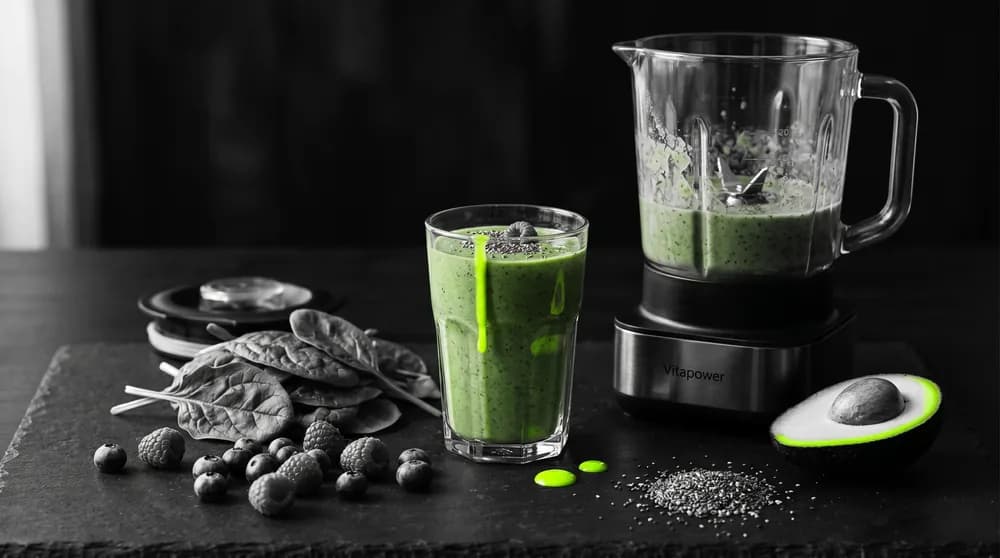
Picture the ultimate health drink and a colorful smoothie almost reflexively comes to mind — a liquid nutrient bomb, "detox," immune boost, glowing skin. But under the biochemical lens the picture turns ambivalent: the right mix really can support cellular health, while store-bought or pure fruit smoothies are often a metabolic trap — spiking blood sugar, triggering cravings, and accelerating aging rather than slowing it.
So the honest question isn't "smoothie, yes or no?" but: what exactly goes into the blender — and what does blending actually do?
Claim vs. evidence at a glance
| Claim | What the evidence shows | Verdict |
|---|---|---|
| Home-blended whole-food smoothies are "ultra-processed" (UPF) | By NOVA: no — store-bought with concentrates/syrup, yes | 🟡 nuanced |
| Blending turns any smoothie into a sugar bomb | False — it depends on the ingredients | 🔴 too sweeping |
| Seeded fruit (berries) blended lowers the glucose curve | RCT crossover: glucose max & iAUC significantly lower than whole fruit | 🟢 supported (small) |
| Pure flesh fruit (mango, banana) blended is neutral-to-risky | Seedless fruit: no benefit; lots of free sugar | 🟡 plausible |
| Sugar in a smoothie "feeds Candida" | Barely supported in humans (mostly animal/petri dish) | 🟠 overstated |
Is a smoothie "ultra-processed"?
A central question of modern nutrition science: does a smoothie count as an ultra-processed food (UPF)? The answer depends on who blended it, and where.
When you blend, the blades destroy the natural food matrix — the intact plant cell walls. The sugar locked inside the fruit cells becomes "free sugar": exactly the category the WHO means when it advises limiting intake (juices and purées count; whole fruit doesn't). Unlike chewing a whole apple, where the gut first has to break down the fibers, a liquid smoothie passes the stomach faster — nutrients and sugar flood into the blood more quickly.
Despite this heavy mechanical processing, a freshly home-blended smoothie made of whole-food ingredients does not fall into the UPF category (NOVA group 4). Ultra-processed, by contrast, are many supermarket smoothies: they sit on the shelf for weeks (losing light- and heat-sensitive vitamins like A and C), and often contain added fruit-juice concentrates, flavorings, stabilizers, or hidden syrups.
Context: "Mechanically pulverized" is not the same as "industrially ultra-processed." The decisive difference isn't the blender, but the ingredients and additives.
The blood-sugar question: whole vs. blended
Here it gets surprising — and this is exactly where the blanket "smoothies spike your blood sugar" warning goes wrong. A controlled crossover study (Crummett & Grosso 2022, Nutrients) had healthy young adults eat apple with blackberries either whole or blended. Result: in the blended mix, both the glucose peak and the total glucose load (iAUC) were significantly lower than with the whole fruit.
The reason: the blades break open the berry seeds and release additional soluble fiber, fats, and polyphenols. Soluble fiber raises gut viscosity and slows sugar absorption.
But — and this is the crucial distinction — it depends on the fruit:
- Seeded fruit (blackberry, raspberry, strawberry): blending can even flatten the curve.
- Seedless, flesh-heavy fruit (mango, banana): here there's no benefit — lots of free sugar, little braking fiber.
- Add-ins work: adding flaxseed or plain yogurt lowers the spike further in trials (~15%).
So the equation is: fiber- and fat-rich seeds make the smoothie safe; pure flesh sugar bombs make it risky. A store-bought juice-based fruit smoothie can easily deliver 300+ kcal and 50–70 g of sugar — that's dessert, not a meal.
What an excess of free sugar does
When the body repeatedly gets a load of liquid sugar without a buffer, the steep rise is followed by an equally steep crash — and that's where the longevity-relevant problems start:
- Insulin roller-coaster & cravings: the rapid drop signals nutrient shortage to the brain → craving for the next fast-carb snack.
- AGEs & cellular aging: repeated steep spikes drive oxidative stress and the formation of advanced glycation end-products (AGEs) — the "caramelization" of proteins makes tissue stiff, burdens vessels, and accelerates skin aging (Uribarri 2010).
- Microbiome: plenty of free sugar with little fiber shifts the gut flora unfavorably — whereas it's fiber that feeds the beneficial bacteria.
Fact-check — "sugar feeds Candida": The popular claim that smoothie sugar fuels Candida albicans overgrowth is barely supported in humans. Controlled human studies found only a limited effect of refined carbohydrate on Candida colonization; the stronger signals come from mouse and test-tube models. The evidence-based lever isn't an "anti-fungal diet" but simply: less free sugar, more fiber.
The honest core remains: "fruit" isn't the problem — excess free sugar without a fiber and fat buffer is. More in the glycemic pillar Hidden sugar & glycemic load.
Green smoothie vs. pure fruit smoothie
The longevity potential only unlocks with the switch from fruit to a real green smoothie:
- Pure fruit smoothie: base of orange or apple juice, plus banana, pineapple, mango. Little protein and fat, maximal fast-available sugar — metabolically a dessert.
- Green smoothie: base of water (never juice) or unsweetened nut milk. Main component dark leafy greens (spinach, kale, chard) — rich in micronutrients that support the mitochondria and aid the liver's detox work. Half an avocado or some plain yogurt makes it creamy, secures absorption of fat-soluble vitamins (A, D, E, K), and stabilizes blood sugar.
The longevity ingredient matrix
How to build a smoothie that keeps you full, repairs tissue (protein), and keeps blood sugar flat:
| Category | ✅ Longevity-promoting | ❌ Metabolically risky |
|---|---|---|
| Liquid base | Filtered water, unsweetened almond/oat milk, green tea | Fruit juices (apple, orange, grape), sweetened plant drinks |
| Vegetables | Kale, spinach, chard, zucchini, cauliflower (frozen) | (Vegetables are rarely the problem — their absence is) |
| Fruit | Wild blueberries, raspberries, strawberries (antioxidants + fiber) | Large amounts of pineapple, mango, very ripe banana, dates |
| Fiber & fats | Chia seeds, ground flaxseed, half an avocado, unsweetened almond butter | Sweetened peanut butter, flavored syrups |
| Protein & extras | Plain Greek yogurt, collagen powder, spirulina, prebiotics | Cheap sweetened protein powders, artificial sweeteners |
For the gut component, look at probiotics and prebiotic fibers like inulin; for fat quality, omega-3.
Build template: a longevity green smoothie
A practical template (1 serving):
- Base: 250–300 ml water or unsweetened almond milk
- Greens: 1–2 handfuls spinach or kale (frozen is fine)
- Fruit: 1 handful frozen berries (seeded!)
- Fat: ½ avocado or 1 tbsp almond butter
- Fiber: 1 tbsp ground flaxseed or chia seeds
- Protein: 150 g plain Greek yogurt or a high-quality, unsweetened protein powder
- optional: cinnamon, a slice of ginger, a pinch of salt
This combination flips the ratio: fiber, fat, and protein slow gastric emptying, the berries deliver polyphenols instead of pure sugar, the greens the micronutrients.
Bottom line
Are smoothies good for longevity? Yes — under clear conditions.
- Risky: store-bought juice-fruit smoothies (UPF, lots of free sugar) and pure flesh mixes of mango/banana.
- Valuable: home-blended, water instead of juice, plenty of greens, seeded berries, and mandatory fiber + healthy fats.
On one point the evidence is strikingly clear: blending itself isn't the problem — what you blend is. With seeds, fat, and protein, the supposed sugar trap becomes a blood-sugar-stable, microbiome-friendly longevity tool. Make the blender your ally — not your metabolic saboteur.
- [1]Crummett & Grosso (2022): Postprandial Glycemic Response to Whole Fruit versus Blended Fruit in Healthy, Young Adults — Nutrients 14(21):4565
- [2]Monteiro et al.: NOVA classification & ultra-processed foods (UPF) — definitional papers
- [3]WHO (2015): Guideline — Sugars intake for adults and children (free sugars, incl. juices/purées)
- [4]Alkutbe et al.: Glycemic index of blended fruit with/without seeds (e.g. mango + passion fruit/raspberry)
- [5]Uribarri et al. (2010): Advanced Glycation End Products in Foods — J Am Diet Assoc
- [6]PubMed search: Dietary carbohydrate & Candida albicans colonization in humans (limited evidence)