Blue Zones: The Secret of Longevity — and the Critique
What's really behind the Blue Zones? The lifestyle pillars of the centenarians, honestly framed — including the scientific critique of the centenarian statistics.

When we struggle with excess weight, chronic stress or exhaustion in the modern world, we often blame ourselves: we simply lack discipline. Research paints a different, more liberating picture — we make most everyday choices semi-automatically, shaped by our environment, not by raw willpower. That's exactly where the fascination with the Blue Zones begins: regions where people supposedly live exceptionally long.
But how robust is the concept really? The honest answer has two layers: the lifestyle lessons are largely well supported — the statistics on centenarians, however, are scientifically hotly contested.
Claim vs. evidence at a glance
| Claim | What the evidence shows | Verdict |
|---|---|---|
| Plant-forward diets with legumes extend life | Robust meta-analyses for CVD/diabetes/mortality | 🟢 well supported |
| Social connection is a strong health factor | Meta-analyses (Holt-Lunstad): isolation ↑ mortality | 🟢 well supported |
| Blue Zones host vast numbers of verified centenarians | Data partly unreliable (registry gaps, pension fraud) | 🔴 highly contested |
| One serving of beans = +4 years, 3 friends = +8 years | Observational/journalistic estimates, not causal | 🟡 plausible but soft |
| Genes determine only 20%, environment 80% | Classic twin estimate; newer analyses closer to ~50% | 🟡 nuanced |
What are the Blue Zones?
The term comes from science journalist Dan Buettner (National Geographic), building on demographic fieldwork (e.g. Poulain & Pes in Sardinia). It refers to regions with supposedly striking numbers of very old people and little chronic age-related disease:
| Blue Zone | Location | Central factors |
|---|---|---|
| Okinawa | Japan | Ikigai (sense of purpose), Moai (lifelong social networks) |
| Sardinia (mountains) | Italy | Isolated shepherd culture, strong family ties, respect for elders |
| Nicoya | Costa Rica | Plan de Vida (purpose), local, unprocessed food |
| Ikaria | Greece | Afternoon naps, social interaction, herbal tea |
| Loma Linda | California, USA | Seventh-day Adventists: Sabbath rest, no alcohol/tobacco, often vegetarian |
| Singapore ("2.0") | Asia | Not historical chance but "designed" via policy & urban planning |
The data fact-check: how robust are the numbers?
Here's the part most Blue Zones articles leave out — and it's decisive for an honest framing.
Demographer Saul Newman (UCL) received the 2024 Ig Nobel Prize for work showing that extremely high "100+" rates are strikingly well predicted by poverty, missing birth certificates and poor civil registries — factors that have nothing to do with real longevity. When US states introduced birth certificates, the number of "supercentenarians" collapsed by 69–82%. Many supposedly ancient people were alive in the records but long dead in reality — partly pension fraud, partly sheer documentation chaos.
Context: This does not mean the lifestyle lessons are wrong. It means: the spectacular centenarian statistics of individual regions should be taken with caution. The smart move is to look at what is independently well supported — plant-forward diet, movement, social connection — not to chase the next "hotspot." It's also why Gundry's idea that smoking in Blue Zones is healthy is doubly baseless.
The lifestyle pillars — what actually holds up
Strip away the shaky statistics and a robust core remains, consistent with mainstream nutrition and prevention research.
1. Diet: the "peasant kitchen"
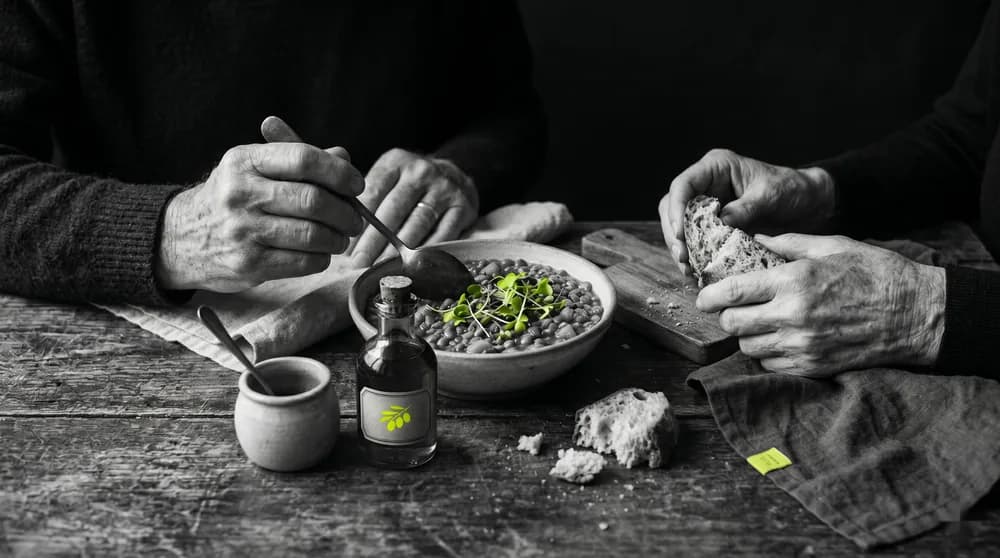
In the classic Blue Zones the diet is largely plant-based and whole: whole grains, leafy greens, tubers, nuts — and above all legumes. That's no accident: legumes and whole grains are among the best-supported protective foods (Aune 2016; legume meta-analyses). They provide complex carbohydrates and fiber that feed the microbiome and dampen low-grade inflammation.
The popular figure "one serving of beans = +4 years of life" comes from observational data and is more rule of thumb than causal proof — but the direction (more legumes = healthier) is solid. Meat plays a side role (a few times a month, small portions). Prebiotic fibers like inulin and Mediterranean fats like olive-oil polyphenols fit the same pattern. More: nutrient density — animal vs. plant.
2. Eating in moderation: Hara Hachi Bu
In Okinawa the mantra Hara Hachi Bu reminds people to stop eating when the stomach is 80% full. Since the satiety signal takes ~20 minutes, slow, moderate eating prevents overeating. Biologically this eases the mitochondria and — via longer eating breaks — promotes autophagy, cellular waste clearance (CR & autophagy). That indirectly protects against insulin resistance, the precursor of type 2 diabetes.
3. Natural movement instead of the gym
Nobody in the Blue Zones does HIIT. Movement is built into daily life: gardening, walking to a neighbor, stairs, manual work. This constant, low-threshold activity guards against sarcopenia (age-related muscle loss) — the structured version is in Exercise & longevity: the 5 pillars.
4. The social immune system
Perhaps the most underrated factor. The meta-analysis by Holt-Lunstad (2010) shows: good social relationships lower mortality on a scale that rivals classic risk factors; isolation raises mortality risk by about 29%.
Caveat: The oft-quoted line "loneliness is as deadly as 15 cigarettes a day" is a catchy rule of thumb — newer analyses temper the direct comparison. The "3 friends = +8 years" figure is likewise an estimate, not a law of nature. What's not in dispute: social integration, purpose, and rest rituals (naps, Sabbath, prayer) lower stress and cortisol — and chronic stress accelerates cellular aging via shortened telomeres.
Genes or environment?
It's often said genes determine only 20% of life expectancy, the rest being lifestyle. That's the classic twin-study estimate (~20–25%, some family studies even lower) — and the source of the liberating "80% is in your hands" message. But honestly: newer analyses that correct for external causes of death (accidents, infections) estimate the genetic share of intrinsic lifespan closer to 50% (overview).
The practical takeaway is the same: the lifestyle lever is yours to pull — whether it accounts for 50% or 80%.
Decline — and Singapore as "Blue Zone 2.0"
As fascinating as the regions are, they're fragile: once Western fast food, processed meat and sugary snacks move in, the advantage vanishes. Okinawa now battles the highest obesity rates in Japan.
The hope comes from Singapore: the city-state massively raised life expectancy within a generation — through choice architecture: sugar taxes, promotion of whole grains, pedestrian-friendly urban planning. The exact "+20 years in one generation" figure is Buettner's flourish, but the mechanism is the real point: make the healthy choice the easiest one and you need less discipline.
Bottom line
The Blue Zones as a brand narrative should be taken with caution — the centenarian statistics of individual places are scientifically on the ropes. But what remains is robust and independently supported:
- plant-forward whole-food diet with plenty of legumes,
- moderate eating and longer eating breaks,
- natural everyday movement,
- social connection, purpose and rest rituals.
The real lesson isn't "move to Ikaria," but: design your environment so the healthy choice is the easiest one. Longevity isn't forced through iron discipline — it emerges as a by-product of a well-built daily life. What "longevity" means overall is framed in What is longevity?.
- [1]Poulain et al.: Identification of the Sardinia longevity region (AKEA study) — Experimental Gerontology
- [2]Newman (UCL, 2024): Critique of Blue Zones / supercentenarian data (Ig Nobel, Demography)
- [3]Holt-Lunstad et al. (2010): Social Relationships and Mortality Risk — meta-analysis (PLOS Medicine)
- [4]Aune et al. (2016): Whole grain consumption & risk of CVD, cancer & mortality — meta-analysis (BMJ)
- [5]Systematic review & meta-analysis: Legume consumption, cardiovascular risk & type 2 diabetes
- [6]PubMed search: Heritability of human lifespan (twin studies)
- [7]PubMed search: Caloric restriction, autophagy & longevity