Berberine: Blood Sugar, LDL and the Ozempic Myth
Berberine lowers HbA1c and LDL in RCTs by activating AMPK like metformin. But the 'Nature's Ozempic' weight-loss and longevity claims are hype. The honest evidence.

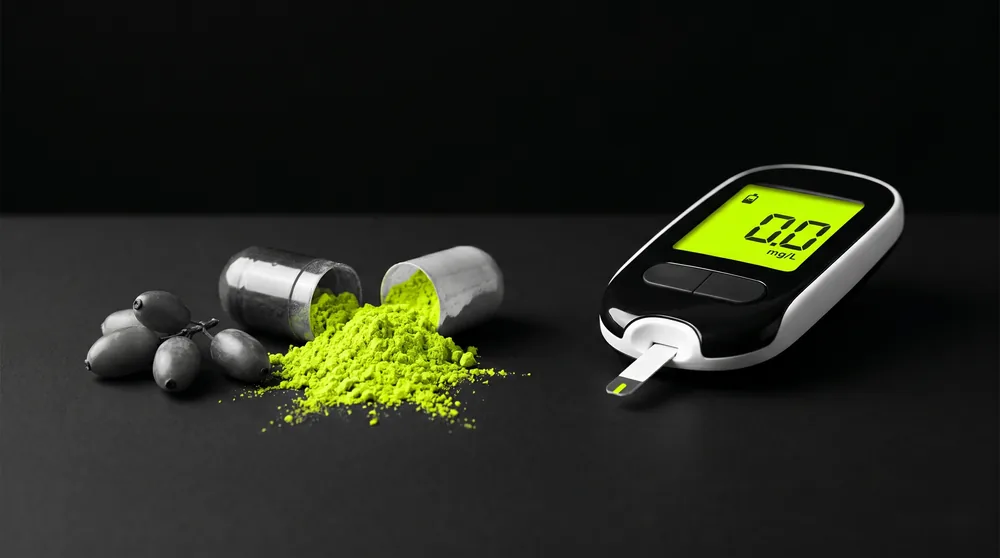
Few supplements have ridden a viral wave quite like berberine. On TikTok it became "Nature's Ozempic" overnight — a cheap plant alkaloid that supposedly melts fat the way semaglutide does. The truth is more interesting and far less dramatic: berberine is a genuine metabolic agent with real, randomized-trial evidence behind its effects on blood sugar and LDL cholesterol. But the weight-loss and anti-aging mythology around it doesn't survive contact with the data. So what does berberine actually do — and where does the hype begin?
The evidence at a glance
| Claim | What the evidence shows | Verdict |
|---|---|---|
| Lowers HbA1c and fasting glucose in type-2 diabetes | Meta-analyses: HbA1c −0.5 to −0.7%, fasting glucose ~−0.8 mmol/L (~15 mg/dL) | 🟡 moderate |
| Lowers LDL cholesterol and triglycerides | Lan 2015 meta-analysis: LDL −0.65 mmol/L (~25 mg/dL) | 🟡 moderate |
| Reduces colorectal adenoma recurrence | Lancet 2020 RCT: 36% vs 47% recurrence (RR 0.77) | 🟡 moderate |
| As strong as metformin for glucose | Single small open-label trial (n=36) | 🔴 weak |
| Modest reductions in BMI / waist | Inconsistent; ~0.5–2 kg, several pools find no effect | 🔴 weak |
| "Nature's Ozempic" — major weight loss | GLP-1 drugs lose 10–20% body weight; berberine doesn't come close | 🔴 false |
| Extends human lifespan | Animal/cell data only — no human endpoint | 🔴 weak/animal |
| "Natural, so harmless" | Inhibits CYP3A4 and P-glycoprotein — real drug interactions | 🔴 false |
What berberine is — and how it works
Berberine is an isoquinoline alkaloid, the bright-yellow compound found in plants like Coptis, barberry (Berberis) and goldenseal. It has been used in traditional Chinese and Ayurvedic medicine for centuries, mostly as an antimicrobial. Its modern reputation rests on something far more specific: its effect on cellular energy sensing.
The best-supported mechanism is inhibition of mitochondrial respiratory complex I (Turner & Brusq, Diabetes 2008). By partially blocking the mitochondria's energy production, berberine lowers the cellular ATP/ADP ratio and raises AMP. That shift activates AMP-activated protein kinase (AMPK) — the same energy-sensing master switch that the diabetes drug metformin targets. When AMPK fires, the liver takes up more glucose, glycolysis increases, and fat synthesis (via SREBP-1c and ACC) is suppressed.
That metformin parallel is the heart of berberine's appeal. You can read more about that drug in our metformin profile, and about berberine itself in the berberine database entry.
The cholesterol effect runs on a separate track. Largely independent of AMPK, berberine stabilizes hepatic LDL-receptor mRNA and suppresses PCSK9 (via the transcription factor HNF-1alpha), which increases LDL clearance from the blood. It also inhibits intestinal alpha-glucosidase (slowing carbohydrate breakdown) and reshapes the gut microbiome.
Important: Not all of berberine's glucose-lowering runs through AMPK. AMPK is the major route, but some effect persists without it — a reminder that this is a multi-target molecule, not a clean single-pathway drug.
What is actually proven
Strip away the marketing and a respectable, RCT-backed core remains.
Blood sugar (moderate evidence)
Multiple meta-analyses converge on the same picture. A 2022 Frontiers in Pharmacology pool of 37 trials (n = 3,048) found berberine lowered HbA1c by about 0.63% and fasting glucose by ~0.82 mmol/L (roughly 15 mg/dL). The earlier Lan 2015 meta-analysis (27 trials) reported a similar fasting-glucose drop of −0.86 mmol/L. For context, metformin lowers HbA1c by roughly 1% at 500 mg twice daily — so berberine lands in a real but more modest range.
Lipids (moderate evidence)
The same Lan 2015 analysis found berberine lowered LDL cholesterol by ~0.65 mmol/L (about 25 mg/dL) versus placebo, alongside reductions in total cholesterol and triglycerides. Mechanistically this fits the PCSK9/LDL-receptor story cleanly. This dual glucose-and-lipid action is what makes berberine genuinely interesting for metabolic syndrome.
Colorectal adenoma recurrence (moderate evidence)
The strongest single study is also the least talked about. In a multicenter, double-blind RCT (Chen et al., Lancet Gastroenterology & Hepatology 2020), patients took 0.3 g berberine twice daily after polyp removal. Adenoma recurrence was 36% versus 47% on placebo (RR 0.77, P = 0.001), and a 6-year follow-up sustained the effect. This is arguably berberine's most clinically meaningful signal.
Versus metformin (weak evidence)
The famous head-to-head is Yin et al. 2008 (Metabolism, n = 36): over three months berberine cut HbA1c from 9.47% to 7.48%, almost identical to metformin (9.15% to 7.72%), with lipids improving more on berberine.
Caveat: This was a small, single-center, open-label trial in newly diagnosed patients. It generated the "as good as metformin" headline, but one study of 36 people is not a verdict — treat it as a hypothesis, not proof.
The overrated and the false
This is the part the supplement industry would rather skip.
"Nature's Ozempic." This is the claim that built the hype, and it is simply false. Pooled weight change across trials is roughly 0.5 to 2 kg over months — and several meta-analyses find no significant body-weight effect at all. GLP-1 drugs like semaglutide and tirzepatide produce 10–20% body-weight loss through an entirely different mechanism (appetite and satiety signaling). The NCCIH and UCLA Health have both explicitly debunked the comparison. Berberine is not a weight-loss drug.
"Dihydroberberine is the superior, well-absorbed form." Overstated. The headline human evidence is a single tiny, industry-funded crossover pilot (Moon et al. 2022, Nutrients) in just 5 healthy young men. It showed higher plasma berberine at a lower dose — but no significant difference in glucose or insulin. Better pharmacokinetics on paper; no proven clinical advantage.
"Berberine extends lifespan." Not shown in humans. Lifespan extension exists only in animals and cells — Dang et al. 2020 (Aging Cell) extended residual lifespan in naturally aged mice via senescence (p16/mTOR) pathways, with effects also seen in flies and fibroblasts. This is mechanistic and animal data. There is no human longevity endpoint. The same honest framing applies to other "anti-aging" supplements — see our longevity supplements overview and, for the NAD angle, NMN.
"Natural, so it's gentle." False, and the most dangerous misconception. Berberine inhibits CYP3A4 and P-glycoprotein in humans — it raised midazolam Cmax by ~38% and markedly increased cyclosporine levels in human pharmacokinetic studies. That means real interaction risk with statins, immunosuppressants and many other drugs.
Safety and interactions
Wichtig — read before you stack anything:
- GI side effects are common (~30–35%). In Yin 2008 the overall rate was ~34.5% — flatulence ~19%, diarrhea ~10%, constipation ~7%, abdominal pain ~3%. Mostly transient and dose-dependent; often eased by dropping to 300 mg three times daily.
- Drug interactions are real. CYP3A4 and P-glycoprotein inhibition can raise blood levels of statins (myopathy/liver risk), cyclosporine and other immunosuppressants, and certain blood-pressure and antiarrhythmic drugs. Do not combine without medical supervision.
- Additive hypoglycemia risk when stacked with metformin, sulfonylureas or insulin.
- Contraindicated in pregnancy, breastfeeding and newborns — berberine crosses the placenta and can displace bilirubin, risking kernicterus.
- It is a supplement, not a drug in the US and EU: no FDA/EMA oversight of purity or dose accuracy, and limited long-term safety data.
- It is not a substitute for prescribed diabetes or lipid therapy. If you have a diagnosed condition, involve your physician.
Practical dosing and buying
The dose used in most type-2 diabetes trials is 500 mg three times daily (1,500 mg/day) with meals — splitting the dose matters because berberine has poor bioavailability and a short half-life. The Lancet adenoma trial used a lower 300 mg twice daily. If GI side effects appear, lowering to 300 mg three times daily usually helps.
Because supplement quality varies and dose labels aren't regulated, favor third-party-tested products from a reputable brand, and avoid combination "metabolism" formulas that hide the actual berberine content.
Who is it actually for?
Berberine makes the most sense for someone with prediabetes, metabolic syndrome, or elevated LDL who wants an evidence-backed adjunct — and who has cleared it with their doctor to rule out drug interactions. If your fasting glucose, HbA1c or LDL are borderline, those are exactly the numbers to measure before and after a trial period (say, 12 weeks) so you know whether it's doing anything for you.
It is not for someone chasing weight loss, expecting an Ozempic-like effect, or hoping to add years to their life. The data simply don't support those uses.
The bottom line
Berberine is a legitimate AMPK-activating metabolic agent. The randomized evidence for modest reductions in blood glucose and LDL cholesterol is real and reproducible, and the colorectal-adenoma signal is genuinely promising. But the viral story — "Nature's Ozempic," a longevity drug, harmless because it's natural — is exactly that: a story. Its weight effect is small and inconsistent, its anti-aging data are animal-only, and its CYP3A4 and P-glycoprotein interactions make "natural equals safe" plainly false. Used honestly, with a doctor in the loop and the right baseline labs, berberine is a useful tool. Used as a TikTok shortcut, it is a disappointment waiting to happen.
- [1]Yin J, Xing H, Ye J (2008): Efficacy of berberine in patients with type 2 diabetes mellitus — Metabolism
- [2]Lan J et al. (2015): Meta-analysis of effect and safety of berberine in T2DM, hyperlipidemia and hypertension — J Ethnopharmacology
- [3]Glucose-lowering effect of berberine on type 2 diabetes: systematic review and meta-analysis (2022) — Front Pharmacol
- [4]Turner N, Brusq JM et al. (2008): Berberine and dihydroberberine inhibit mitochondrial complex I to activate AMPK — Diabetes 57:1414
- [5]Chen YX et al. (2020): Berberine vs placebo for prevention of colorectal adenoma recurrence (RCT) — Lancet Gastroenterol Hepatol
- [6]Asbaghi O et al. (2020): Berberine supplementation on obesity parameters — meta-analysis of RCTs