Sugar Alternatives Compared: What Gut, Blood Sugar and the Studies Really Say
Erythritol, xylitol, stevia, allulose, date paste & co. — honestly compared on blood sugar, gut tolerance and safety. Why 'natural' is no free pass.

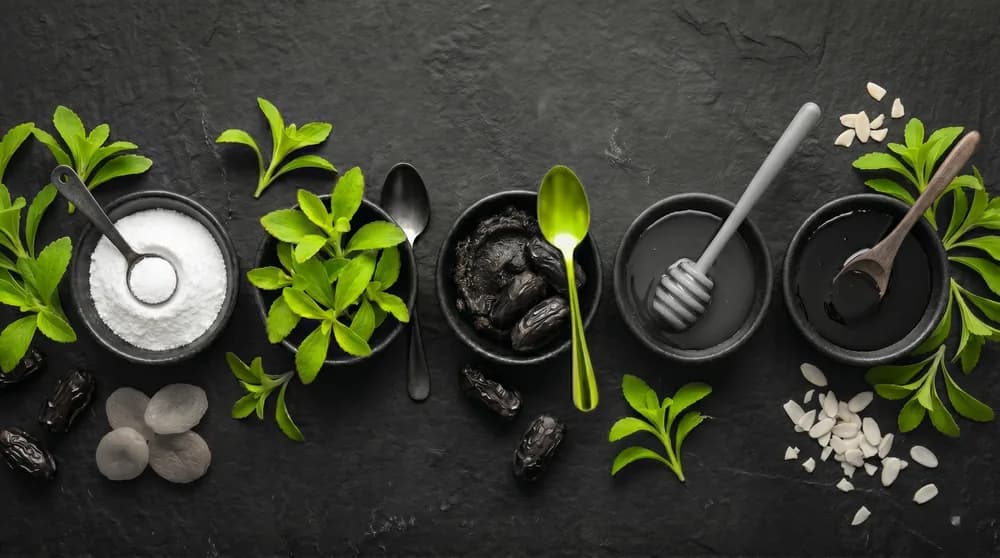
"Which sugar substitute is best?" is a trick question — because the real goal is to eat less sweet overall and retrain your palate. But if you do sweeten, an honest comparison along three dimensions pays off: blood sugar, gut tolerance, and safety. And up front: "natural" is not a free pass.
Framing up front: there's no single winner. Sugar alcohols are tooth-friendly but can bloat; sweeteners are calorie-free but microbiome data are mixed; "natural" syrups (agave, honey) are still sugar. The best is usually real food with its own sweetness (dates, fruit) — or simply less.
The overview
| Sweetener | Blood-sugar impact (GI) | Gut | Verdict |
|---|---|---|---|
| Table sugar / syrups | high (GI ≈ 65) | feeds unfavorable microbes | 🔴 standard, reduce |
| Agave syrup | lower GI, but high fructose | liver/microbiome load | 🔴 barely better than sugar |
| Erythritol | virtually 0 | good, but a caveat (below) | 🟡 with caution |
| Xylitol | low (GI ≈ 13) | bloating/laxative; toxic to dogs | 🟡 situational |
| Stevia | 0 | usually well tolerated | 🟢 solid |
| Monk fruit | 0 | usually well tolerated | 🟢 solid |
| Allulose | virtually 0 | little human data, not EU-approved | 🟡 promising |
| Synthetic sweeteners* | 0 | microbiome data mixed | 🟡 ok within limits |
| Date paste / fruit | moderate, but with fiber | fiber + polyphenols | 🟢 best for baking |
| Yacon syrup | low (FOS) | prebiotic, "gut food" | 🟢 intriguing, in moderation |
| Inulin / chicory syrup | very low | prebiotic fiber | 🟢 in moderation (can bloat) |
| Sorbitol / maltitol / isomalt | low–moderate (maltitol higher) | strongly bloating/laxative | 🟡 caution |
| Tagatose | low | usually well tolerated | 🟡 niche |
*Aspartame, sucralose, acesulfame-K, saccharin. GI = glycemic index (scale 0–100; glucose = 100, table sugar ≈ 65). 0 = practically no blood-sugar rise; where no number is given the data are too inconsistent for a credible figure.
"Natural" syrups: mostly just sugar with good PR
Agave syrup, rice syrup, coconut sugar, maple/date syrup sound healthy — but are mostly sugar. Agave does have a lower glycemic index, but a very high fructose content that can burden the liver more than table sugar. Coconut sugar has slightly more minerals and a lower GI, but remains sugar. Bottom line: no meaningful health advantage over regular sugar.
Sugar alcohols (erythritol, xylitol): tooth-friendly, but with a catch
Sugar alcohols provide almost no calories, barely raise blood sugar, and are good for the teeth. The catch: they're poorly absorbed in the small intestine → bloating and a laxative effect, especially in sensitive guts. Xylitol is highly toxic to dogs (households with dogs: be careful).
Important erythritol caveat: a widely noted study (Witkowski et al. 2023, Nature Medicine) linked high blood erythritol levels with more cardiovascular events and showed a plausible mechanism (increased platelet activation). This is not yet proven causality (observation + mechanism), but enough to no longer recommend erythritol carelessly in large amounts.
Sweeteners: stevia & monk fruit lead
High-intensity sweeteners are calorie-free and blood-sugar-neutral. For the synthetic ones (aspartame, sucralose, acesulfame-K, saccharin): within the approved daily intakes (ADI), regulators classify them as safe — though microbiome effects are mixed in studies (Suez et al.), and in 2023 the WHO advised against using them for weight control. (Aspartame was classified in 2023 by IARC as "possibly carcinogenic," but JECFA kept the ADI — so: no acute alarm at normal amounts, but no reason for heavy chronic use.)
Plant-derived sweeteners — stevia and monk fruit — come out best overall: calorie-free, blood-sugar-neutral, usually well tolerated. Tip: choose "clean" products without unnecessary fillers.
Allulose: intriguing, but immature
Allulose is a "rare sugar," tastes almost like sugar, provides almost no calories, and barely raises blood glucose. But: not (yet) approved in the EU, little long-term and human data, GI upset at higher amounts. Promising — wait and see.
The best choice: sweetness from real food
If you bake or sweeten, whole fruit is usually the best option: date paste/dates, banana, apple puree, prunes. Here the sweetness comes with fiber and polyphenols — pectin (apple) and resistant starch (unripe banana) are even "food" for good gut bacteria, and absorption is slower. Still, it remains natural sugar — mind the quantity.
Lesser-known, but worth mentioning
These options rarely show up in the usual comparisons — but they're interesting, especially from a gut perspective:
- Yacon syrup: rich in fructooligosaccharides (FOS) — i.e. prebiotic fiber that feeds good gut bacteria. Low glycemic index; bloating in larger amounts. From a gut perspective, one of the most intriguing alternatives.
- Inulin / chicory syrup: fiber-based sweetness with barely any blood-sugar effect and a prebiotic action — but sensitive stomachs react with bloating.
- Other sugar alcohols (sorbitol, maltitol, isomalt): found in many "sugar-free" candies and sweets. Important: maltitol has a relatively high glycemic index (unlike erythritol) — and all of them can cause significant bloating and a laxative effect in quantity.
- Tagatose: a "rare sugar" with a low GI and only ~1.5 kcal/g; not widely available yet, but usually well tolerated.
Bottom line
There's no perfect sugar substitute — there are fitting tools for the job:
- For baking: date paste/fruit (🟢) — sweetness with fiber.
- For coffee/drinks: stevia or monk fruit (🟢), blood-sugar-neutral.
- Teeth/low-carb: sugar alcohols situationally — erythritol with the caveat above.
- Avoid/reduce: agave & "natural" syrups (🔴) are just sugar.
But the biggest lever remains: dialing down the sweet stimulus altogether. More on the blood-sugar background in the piece on keto & insulin resistance.
- [1]WHO (2023): guideline on non-sugar sweeteners (NSS)
- [2]Witkowski et al. (2023): erythritol & cardiovascular events — Nature Medicine
- [3]PubMed search: sweeteners & gut microbiome (Suez et al.)
- [4]PubMed search: sugar alcohols, GI tolerance & bloating
- [5]PubMed search: stevia & monk fruit — safety & glycemic
- [6]PubMed search: aspartame — JECFA/IARC assessment 2023
- [7]PubMed search: yacon syrup / FOS & gut microbiome (prebiotic sweetness)