Nitrite, Phosphates & the Nitrate Paradox in Meat
The EU is lowering nitrite limits over cancer risk — yet nitrate is healthy in vegetables. The nitrate paradox explained, plus the underrated phosphates.

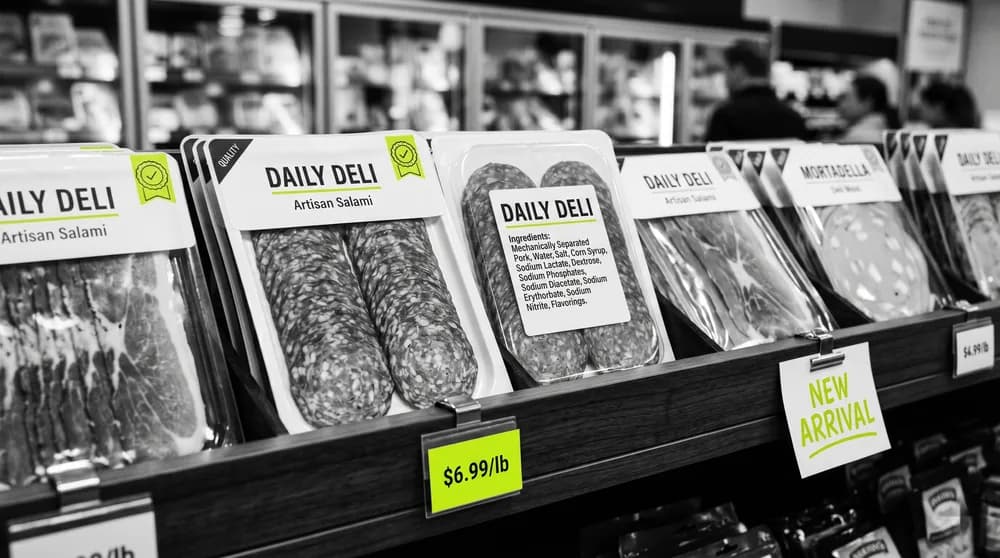
"Over cancer risk: new EU nitrite limits for food" — headlines like that understandably cause worry. At the same time, we tell you that nitrate from vegetables is healthy and lowers blood pressure via nitric oxide (NO). How do these fit together? The resolution is the nitrate paradox — and it's the key to putting the panic in perspective.
The core point up front: it comes down to the matrix. The same molecule (nitrate/nitrite) is mostly beneficial in vegetables and potentially harmful in cured meat. No contradiction — two completely different contexts.
The nitrate paradox in one table
| Nitrate from vegetables 🥬 | Nitrite in processed meat 🌭 | |
|---|---|---|
| Accompanying compounds | Vitamin C, polyphenols, fiber | Protein amines, heme iron, often heat |
| What forms | Nitric oxide (NO) | Nitrosamines |
| Effect | Vasodilation, blood pressure ↓ | DNA damage, carcinogenic |
| Verdict | healthy (see the NO article) | avoid/reduce |
The decisive point: in vegetables, the accompanying antioxidants (especially vitamin C) prevent conversion to nitrosamines and steer the path toward NO. In cured meat, by contrast, nitrite, protein building blocks, and heme iron meet — and with heat (frying bacon!) and in the stomach, nitrosamines form.
Nitrite in sausage: why it's there — and what the problem is
Sodium nitrite (E250) isn't added out of malice. It has real functions:
- Color & appeal: produces the typical red (without nitrite, sausage turns greyish).
- Protection from microorganisms: inhibits dangerous germs, especially Clostridium botulinum (botulism) — a genuine food-safety benefit.
- Longer shelf life.
Honestly assessed: the red color only fakes freshness — it says nothing about quality. And nitrite inhibits germs, it doesn't kill them; refrigeration and hygiene remain decisive. The shelf-life benefit is technological, not a health argument.
The risk — and what the evidence says: processed meat is classified by the IARC (2015) as a Group 1 carcinogen — the same category as tobacco smoke, which refers to the strength of the evidence, not the degree of danger. The basis is large cohort meta-analyses: per 50 g of processed meat daily, colorectal cancer risk rises by about 18%. Important context: that's a relative increase on a moderate baseline (lifetime colorectal-cancer risk ~5–6%) — and it's dose-dependent, rising with the amount. The main mechanism is nitrosamines (plus heme iron). Unprocessed red meat, by the way, is only classified as "probably carcinogenic" (Group 2A) — weaker evidence. That's why the EU is lowering permissible nitrite amounts. The risk rises with regular, high intake; an occasional sausage is not a disaster. Helpful: vitamin C in the product (ascorbic acid, often added as an antioxidant) inhibits nitrosamine formation — while heavy searing/grilling increases it.
Phosphate additives: the underrated second compound
On many sausage ingredient lists, alongside nitrite you'll see "diphosphates" / "phosphates" (E338–E452) — as a stabilizer. The problem (review by Ritz et al. 2012, Dtsch Arztebl):
- Added inorganic phosphates are almost fully absorbed by the body — unlike the organically bound phosphate in natural foods (~40–60%).
- A high phosphate load is associated with vascular calcification and cardiovascular risk — best established in kidney patients, "emerging" for the general population.
Practically: scan the ingredient list for "phosphate" — it hides in sausage, processed cheese, cola, and many convenience foods.
What you can practically do
- Reduce processed meat — don't demonize it, but don't eat it daily. (Fresh, unprocessed meat is a different category.)
- Read the ingredient list: sodium nitrite/"curing salt" (E250) and "phosphate" are the two markers. Nitrite-free/low options exist.
- Eat vegetable nitrate without worry — beetroot, spinach, arugula are healthy (that's the good end of the paradox).
- If you do eat sausage, do it smartly: pair it with vitamin-C-rich vegetables, and don't char it.
Perspective, not alarm: topics like this are often dramatized on social media. Soberly assessed, it's about patterns, not single instances: if you keep the bulk of your diet unprocessed, you don't need to fear the occasional salami.
Bottom line
The nitrate paradox explains the apparent contradiction: nitrate from vegetables → healthy NO; nitrite in cured meat → carcinogenic nitrosamines. The new EU limits are sensible, not a reason to panic. Reduce processed meat and hidden phosphates, read the ingredient list — and keep eating your green vegetables with a clear conscience. More on the mechanisms in our pieces on nitric oxide, oral health & the microbiome, and cancer, immunity & nutrition.
- [1]IARC / WHO: processed meat as a Group 1 carcinogen
- [2]PubMed search: nitrosamines, processed meat & colorectal cancer
- [3]Lundberg et al.: the nitrate-nitrite-NO pathway (vegetables → nitric oxide)
- [4]Ritz et al. (2012): Phosphate additives in food — a health risk (Dtsch Arztebl)
- [5]PubMed search: vitamin C inhibits nitrosamine formation
- [6]EFSA: re-evaluation of nitrites/nitrates as food additives