Nitric Oxide (NO): The Molecule That Keeps Your Blood Vessels Young
Biochemist Nathan Bryan calls age-related NO loss the first domino of chronic disease. What's solid, what's overstated — and four evidence-based ways to raise NO naturally.

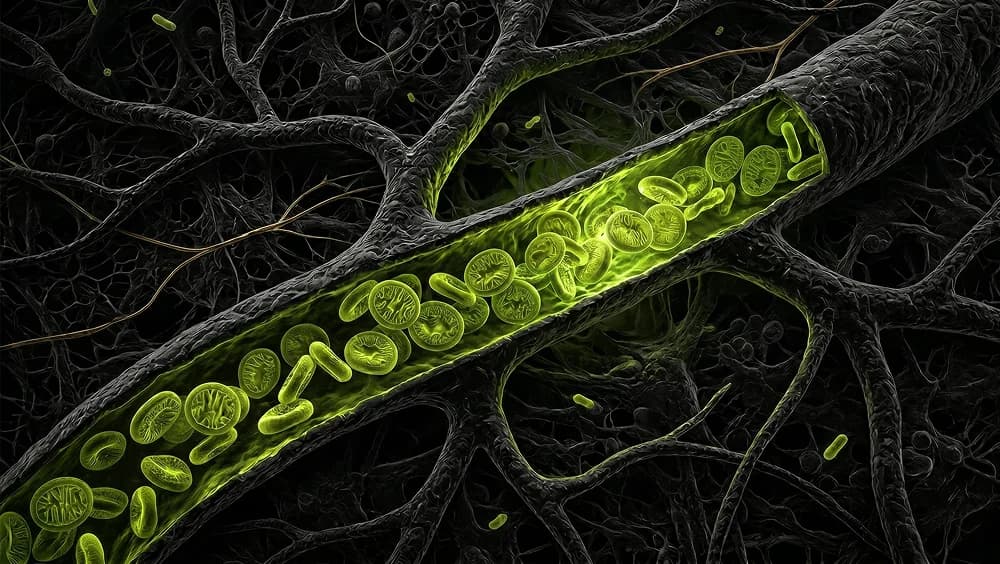
It's a gas that exists for only a fraction of a second in the body — yet it co-decides blood pressure, vascular age, and perfusion. Nitric oxide (NO) is a central signaling molecule of the blood vessels. Biochemist Dr. Nathan Bryan, who has researched it for nearly two decades, goes further: age-related NO loss, he argues, is the first domino of almost every chronic disease of civilization.
It's a bold thesis. This article explains what's well supported in the NO story, where Bryan overstates it — and which four levers measurably raise your NO production.
Framing up front: NO is real and important — but it's one factor in a complex system, not the single master switch for "every" disease. Where Bryan's claims run beyond the established evidence, we flag it. Nothing here replaces medical advice; never stop prescribed medications (e.g. acid blockers) on your own.
NO at a glance
| What NO does | Evidence | |
|---|---|---|
| Vasodilation | Relaxes vascular muscle, lowers blood pressure | Strong (textbook) |
| Perfusion | Optimizes oxygen/nutrient supply to organs | Strong |
| Mitochondria | Modulates oxygen turnover and energy balance | Moderate |
| Stem cells / telomerase | Involved in repair processes | Mechanistic, not conclusive |
| "First domino of all disease" | Bryan's overarching thesis | Hypothesis, not consensus |
What is nitric oxide — and why does it matter?
Often confused with laughing gas (nitrous oxide, N₂O — the dental anesthetic), nitric oxide (chemically NO) is an endogenous gas produced mainly in the endothelium — the innermost cell layer lining our blood vessels.
Its main job is vasodilation: when endothelial cells release NO, the surrounding smooth muscle relaxes, vessels widen, blood pressure drops, and tissues are better perfused. That NO plays this role is textbook knowledge — and earned the 1998 Nobel Prize in Medicine.
NO is also credited with a role in further processes:
- Helping mobilize the body's own stem cells for tissue repair.
- Influencing the enzyme telomerase, which maintains the protective caps of our chromosomes (telomeres).
- Modulating energy production in the mitochondria.
Caveat: These three points are mechanistically plausible and supported by cell/animal models — but not established as a robust clinical effect in humans. Depending on concentration, NO can even inhibit telomerase rather than activate it. Bryan often presents this as a proven anti-aging effect; that's an overreach.
Aging as NO deficiency — the solid core and the overstated numbers
What's undisputed: with age, the function of eNOS (endothelial NO synthase) declines. Oxidative stress "uncouples" the enzyme, vessels stiffen, on-demand widening fades — the endothelial dysfunction. The heart must pump the same volume through narrower, stiffer pipes.
Bryan likes to put a number on it: roughly 10–12 % NO loss per decade of life, about −50 % by age 40 and up to −75 % by age 70–80.
Context: The trend is solid; the exact percentages are Bryan's estimate — not a consensus figure. Treat them as a rough illustration, not a measurement.
Several conditions correlate with the NO decline:
- Erectile dysfunction (ED) — the "canary in the coal mine." The fine vessels of the genitals respond early to fading vasodilation; clinically, ED is a recognized early warning sign of systemic cardiovascular disease. (Well established.)
- Hypertension & cardiovascular disease — if vessels stay narrow and stiff, pressure rises. (Well established.)
- Insulin resistance & diabetes — NO is involved in the vascular insulin-signaling cascade; impaired NO production and insulin resistance reinforce each other. (Plausible; more in the piece on keto & insulin resistance.)
- Alzheimer's dementia — a vascular component is increasingly recognized: reduced cerebral perfusion contributes to pathology, and amyloid-β can impair NO production via the CD36 receptor. (Associated/mechanistic — not "Alzheimer's is a vascular disease.")
The hidden NO brakes
Bryan's most valuable contribution: many everyday habits sabotage NO production without our noticing. Here he's mostly on solid ground — with one important exception.
1. Antiseptic mouthwashes
The nitrate–nitrite–NO pathway is real: nitrate-reducing bacteria on the tongue convert nitrate from green vegetables into nitrite, from which the body can form NO. Antiseptic mouthwash decimates this oral microbiome.
Number corrected: In the podcast the figure "+26 mmHg" comes up. That's factually wrong. The real evidence (Kapil et al. 2013) shows a blood-pressure rise of ~2–3.5 mmHg systolic after chlorhexidine rinsing — measurable and relevant for vascular health, but an order of magnitude smaller. It's also documented (Cutler et al. 2019) that mouthwash blunts the blood-pressure-lowering effect of exercise.
2. Fluoride in toothpaste — Bryan's most contested claim
Bryan classifies fluoride as a strong antiseptic and a potential neuro- and thyroid toxin that disrupts the oral microbiome.
A clear assessment — minority position: Neuro- and thyroid effects of fluoride are documented only at high exposure (regions with heavily fluoridated drinking water, fluorosis) — not at the low dose from normal toothpaste. That fluoride toothpaste clinically wipes out nitrate-reducing bacteria is not established. Against this stands the excellently documented cavity protection. Do not drop fluoride on the strength of this hypothesis — caries is a real, NO-independent risk. If you still want to reduce it, discuss it with your dentist.
3. Acid blockers (PPIs)
Without an acidic stomach environment, swallowed nitrite is converted to NO less efficiently; PPIs also lower the absorption of magnesium, B12, and zinc. Mechanistically plausible.
Caveat: PPIs are often prescribed for good reason (reflux, ulcer prophylaxis). Never stop them on your own — only question them under medical guidance.
4. Sugar & glycation
Chronically high blood sugar drives glycation: sugar molecules attach to proteins — including eNOS — and impair their function. This helps explain why people with diabetes are prone to microvascular damage and impaired wound healing. (Directionally well supported.)
4 evidence-based ways to raise NO naturally
| Lever | Mechanism | Evidence |
|---|---|---|
| Nasal breathing & humming | Releases NO from the sinuses | Good (humming ↑ NO markedly) |
| Nitrate-rich vegetables | Raw material for the nitrate–nitrite–NO path | Strong (BP lowering) |
| Exercise | Shear stress stimulates eNOS | Strong |
| Sunlight / red light | Mobilizes skin NO stores | Moderate–good |
- Nasal breathing & humming: The sinus lining produces NO; humming dramatically raises nasal NO concentration (Weitzberg & Lundberg). Consistent nasal breathing widens the upper airways and improves oxygen uptake.
- Nitrate-rich diet — with an intact oral milieu: Beetroot, spinach, arugula, and chard supply nitrate; meta-analyses show a measurable drop in blood pressure. A tongue scraper can break up the biofilm and support bacterial diversity — antiseptic mouthwash, by contrast, should be avoided.
- Regular exercise: Blood flow generates shear forces on the vessel wall that stimulate eNOS — see also our 5 pillars of exercise.
- Sunlight (UVA & infrared): Certain light frequencies mobilize NO from skin stores; UVA acutely lowers blood pressure (Liu et al. 2014). More in the piece on sunlight, infrared & mitochondria. Keep the dose moderate — skin-cancer protection comes first.
Bottom line
Nitric oxide is rightly a star of vascular medicine: its role in blood pressure and perfusion is Nobel-winning and undisputed. Bryan's merit is making visible how everyday habits — mouthwash, constant sugar — throttle NO production.
Where he overshoots (NO as the cause of all disease, the −26 mmHg number, the fluoride verdict), a sober look pays off. The practical takeaway stays strong and uncontroversial: breathe through your nose, eat nitrate-rich vegetables, move your body, get daylight — and don't rinse away your oral microbiome. That's good vascular medicine, regardless of how far Bryan's grand thesis ultimately carries.
- [1]Dr. Nathan Bryan on *Diary of a CEO* (Steven Bartlett) — basis for this article
- [2]Kapil et al. (2013): Physiological role of nitrate-reducing oral bacteria — antiseptic mouthwash & blood pressure (Free Radic Biol Med)
- [3]Cutler et al. (2019): Mouthwash blunts the blood-pressure-lowering effect of exercise
- [4]Weitzberg & Lundberg (2002): Humming greatly increases nasal nitric oxide
- [5]Liu et al. (2014): UVA radiation mobilizes skin NO stores and lowers blood pressure
- [6]PubMed search: dietary nitrate (beetroot) & blood pressure (meta-analyses)
- [7]PubMed search: eNOS, endothelial dysfunction & vascular aging
- [8]PubMed search: fluoride exposure & neurodevelopment (drinking water, high dose)