Cycle-Based Training & Nutrition: How Women Can Work With Their Hormones
Estrogen and progesterone shift performance, recovery, and metabolism across the cycle. What's proven about cycle-syncing, what's hype — and why menopause is the most important lever.

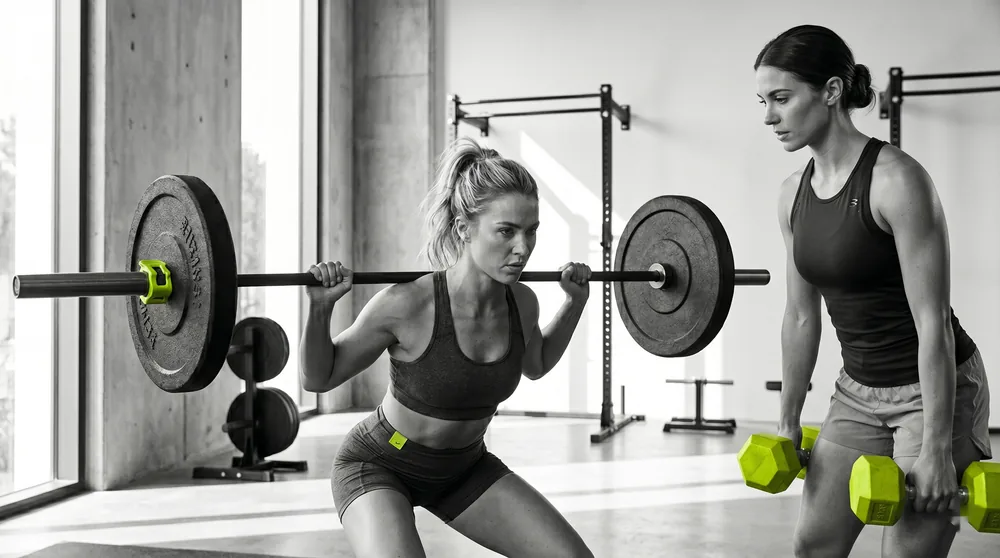
Most longevity and training advice is based on male physiology. Yet across the month the menstrual cycle shifts estrogen and progesterone — and both affect performance, recovery, body temperature, and insulin sensitivity. Aligning training and nutrition to it ("cycle-syncing") is biologically plausible and increasingly popular — even Bryan Johnson includes a detailed female section in his Blueprint protocol.
Honest up front: the mechanisms are real, but the controlled evidence that strict cycle-syncing measurably improves performance is still limited and mixed. Treat this as a sensible framework to experiment with and self-track, not a hard law. The best-supported part is the one often neglected: training around menopause.
The two phases at a glance
| Follicular phase (day 1 → ovulation) | Luteal phase (ovulation → period) | |
|---|---|---|
| Hormones | Estrogen rising, progesterone low | Progesterone high, then falling |
| Insulin sensitivity | Better → more carbs tolerated | Worse → reduce carbs a bit |
| Recovery | Faster | Slower |
| Body temperature | Lower | Elevated (reduces top performance) |
| Training focus | Strength & high intensity / HIIT | Zone 2, lighter training |
| Nutrition | More carbs, moderate protein | More protein & healthy fats |
Follicular phase: push hard
As estrogen rises, insulin sensitivity, muscle building, and recovery improve; the lower body temperature allows harder sessions. Practical: this is the window for strength PRs, HIIT, and higher volume. Carbs are used well — so don't be shy with them around training.
Luteal phase: smarter, not harder
After ovulation, progesterone rises: higher body temperature, slightly more insulin resistance, slower recovery, water retention, and for some, PMS. Practical: more Zone 2 and lighter strength work, a bit more protein and healthy fats, fewer fast carbs. For PMS symptoms and sleep, magnesium, ashwagandha, and rhodiola may help.
Important: individual variation is huge, and hormonal contraception largely flattens the natural cycle — then these phase rules don't apply. Track your cycle and symptoms and adjust by feel rather than following a rigid plan.
Peri- & post-menopause: the best-supported part
When estrogen declines in menopause, muscle (sarcopenia) and bone loss (osteoporosis) and insulin resistance accelerate. Here the evidence is clear and the lever is large:
- Prioritize strength training + HIIT — protects muscle mass, bone density, and insulin sensitivity. Weight-bearing load is central against osteoporosis.
- More protein (~2.0 g/kg body weight/day) for muscle preservation.
- Calcium & vitamin D for bone; creatine supports muscle and increasingly bone too.
This aligns with our 5 pillars of exercise: with age, strength training isn't optional but the most important insurance — especially for women in menopause.
How to put it into practice
- Track your cycle (app/wearable, basal temperature) — identify ovulation.
- Follicular phase: heavy sessions, PRs, HIIT, more carbs.
- Luteal phase: dial volume/intensity back a bit, Zone 2, more protein/fat, magnesium for PMS if needed.
- Adjust by feel — data beats dogma.
- In/after menopause: prioritize strength + HIIT + protein + bone basics.
Bottom line
Women aren't "small men" — the hormonal cycle is a real factor for training, nutrition, and recovery. Cycle-syncing as fine-tuning is plausible and worth an honest self-experiment, even if the hard evidence is still thin. But the biggest, best-supported lever is less glamorous: consistent strength training and enough protein — across the whole cycle and especially through menopause. Track, adjust, keep going.
- [1]PubMed search: menstrual cycle & exercise performance (reviews)
- [2]PubMed search: estrogen, progesterone & muscle recovery
- [3]PubMed search: resistance training & bone density in postmenopause
- [4]PubMed search: protein intake & muscle preservation in aging women
- [5]PubMed search: menstrual cycle & insulin sensitivity
- [6]Bryan Johnson — Blueprint (Female Protocol)