Sleep Science: Chronotypes, Melatonin Myths and the Nightly Reset
How adenosine and the circadian clock drive sleep, why your chronotype dictates peak performance — and what actually helps with sleep problems.

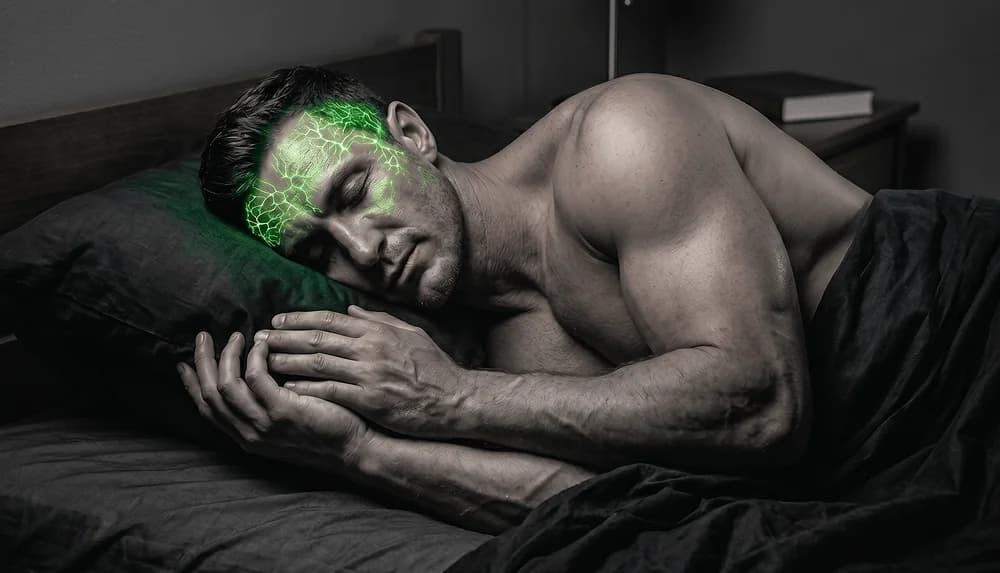
We're in the middle of a global sleep crisis. Recent US-CDC data shows that about a third of adults chronically get less than seven hours of sleep — for teenagers, the share is significantly higher. Clinical psychologist and sleep specialist Dr. Michael Breus has spent two decades researching sleep behavior. The takeaway of modern sleep medicine is clear: good sleep is not a coincidence. It's the result of genetic predisposition, hormonal balance, and deliberate habits.
This article walks through the neurobiological mechanisms of sleep, debunks popular myths around melatonin, and shows how understanding your own biorhythm can dramatically improve quality of life.
The two pillars of sleep: Sleep pressure and the circadian rhythm
To fix sleep problems, you first need to understand how the brain regulates sleep. The human sleep cycle is primarily controlled by two independent but interacting systems:
Sleep pressure (homeostatic drive) — With every waking minute, cells burn glucose for energy. A by-product of this metabolism is the molecule adenosine. The longer you're awake, the more adenosine accumulates at brain receptors, signaling growing tiredness. Sleep breaks adenosine back down.
Circadian rhythm (internal clock) — Your genetically determined 24-hour cycle, primarily dictated by the hormones melatonin (sleep signal) and cortisol (wake signal). The suprachiasmatic nucleus in the hypothalamus orchestrates it via light input from the retina.
The coffee-nap trick (nappuccino)
Caffeine and adenosine have nearly identical molecular structure. Dr. Breus uses this for a biohack against acute fatigue:
- Drink a cooled filter coffee quickly.
- Take a 25-minute power nap immediately after.
- During sleep the brain breaks down adenosine — exactly when you wake, the caffeine blocks the now-free receptors.
The result is an extended, clear energy boost. Evidence comes from driving-performance studies (Reyner & Horne, 1990s): subjects with a coffee-nap react faster than those with nap-only or coffee-only.
Chronotypes: How the internal clock shapes performance
Whether you're a morning person or a night owl is largely not a matter of discipline — it's genetically driven by genes like PER3 (Period Circadian Regulator 3) and other clock genes (CLOCK, BMAL1). The scientific foundation is the long-established morningness-eveningness research; Dr. Breus extends it in The Power of When into a four-type model:
| Chronotype | Share | Peak window | Characteristic |
|---|---|---|---|
| Lion | 10–15% | 09:30–11:30 | Genetic early risers. Melatonin drops early, cortisol rises early. |
| Bear | 50–55% | 11:00–14:00 | Classic type, synchronized to sunlight and "9-to-5". |
| Wolf | ~15% | late afternoon + late night | Night owls. Early rising extremely hard, creative peaks happen late. |
| Dolphin | ~10% | irregular | Highly intelligent, detail-oriented, light sleep, prone to rumination. |
Context: The four-type heuristic is Breus' practical framework, not a scientific consensus. The genetic background is polygenic — in practice you'll often find yourself between two types. The framework remains useful because it helps you identify peak windows instead of fighting your own biology.
Knowing your chronotype affects everyday decisions — ideal coffee time, workout window, even intimacy (testosterone and cortisol peak in the morning while melatonin is low — biologically the most productive window for many people).
The silent epidemic: Sleep apnea and dementia risk
Obstructive sleep apnea (OSA) is one of the most dangerous and at the same time most overlooked sleep disorders. During sleep, the throat muscles relax, the tongue falls back, and the airway is blocked. The sufferer stops breathing — often dozens of times per hour — triggering micro-arousals.
The numbers are alarming: According to Benjafield et al. (Lancet Respiratory Medicine, 2019), ~936 million adults worldwide have OSA — roughly 1 in 7. The dark figure is dramatic: an estimated 80–90% of cases go undiagnosed. Statistically most affected: older men and severely overweight individuals — but the condition occurs across all demographics.
Why OSA ages the brain
Constant breathing interruptions prevent OSA patients from reaching the critical N3 deep sleep (in older classification: stages 3 + 4). It's in this phase that the glymphatic system activates — a kind of "waste-disposal" mechanism in the brain that flushes out toxic protein deposits like beta-amyloid (Iliff & Nedergaard, Science Translational Medicine, 2012).
Without this cleanup the proteins accumulate. Research from the Queensland Brain Institute and other centers associates untreated OSA with ~45% higher risk of cognitive decline and dementia in epidemiological cohorts. Whether this is a direct causal link to Alzheimer's pathology remains under investigation — but the statistical association is robust.
Nighttime waking and 4-7-8 breathing
It's a universal phenomenon: nearly everyone briefly wakes between 1 and 3 a.m. The reason is biological: core body temperature drops to fall asleep. At the lowest point of the night the body has to start re-warming to avoid hypothermia — that temperature rise wakes us briefly.
If you can't get back to sleep, two traps await:
- Checking the clock → instant stress + monkey mind. Turn the display around or move the phone out of the bedroom.
- Actively getting up (bathroom, water, phone) → every movement raises heart rate. To fall asleep, your body needs a calm, low heart rate and active parasympathetic tone.
4-7-8 breathing
The yoga-based technique popularized by Dr. Andrew Weil activates the parasympathetic nervous system via the vagus nerve and measurably lowers heart rate and sympathetic activity:
- Inhale through the nose for 4 seconds
- Hold the breath for 7 seconds
- Exhale through the mouth, controlled, for 8 seconds
- Repeat for 4 cycles
Several small studies show objective HRV improvements after 4–6 weeks of daily practice. Acutely it works for most people within 1–3 cycles.
The melatonin myth
Melatonin is currently the most popular "sleep aid" — US consumption has roughly quadrupled since 2000 (Li et al., JAMA 2022). But the medical reality is more sober:
Melatonin is a hormone, not a classical sedative. It doesn't primarily make you tired — it signals to the brain that it's time to enter rest mode.
Risks of unregulated use:
- Drug interactions with SSRI antidepressants (via CYP1A2 metabolism), blood-pressure medication, and hormonal contraceptives.
- Overdosing: anything above 1.5–3 mg often causes extremely vivid dreams, nightmares, and morning hangover. Studies show physiological doses are around 0.3–0.5 mg — most commercial products are 10–60× too high.
- Children & puberty: Long-term use in healthy children is debated. Animal data suggest possible effects on pubertal development; human studies are still thin — proceed with caution and clinical guidance.
Melatonin is medically indicated primarily for specific scenarios: severe jet lag, shift work, Delayed Sleep Phase Disorder. Not as a generic "make-me-tired" supplement.
What to use instead
Magnesium works differently — as a physiological cofactor for GABA receptors and muscle relaxation. Magnesium glycinate has the best tolerability profile; magnesium L-threonate crosses the blood-brain barrier better and is associated mainly with cognitive endpoints.
Both are better documented than melatonin — for details and the evidence base see the compound database: Magnesium Glycinate.
Dreams: The brain's emotional digestion
Dreams aren't random neural noise — they serve an evolutionary purpose: emotional metabolism. During REM sleep the brain processes the emotional impressions of the day — comparable to a nightly therapy session. Studies show amygdala reactivity to distressing memories measurably drops after a REM-rich night.
When trauma occurs, this process can stall — recurring nightmares are the result. In clinical trauma therapy, Imagery Rehearsal Therapy (IRT) is used (established by Krakow et al.):
- Write the nightmare down during the day.
- Consciously rewrite the ending positively.
- Read or visualize the new version several times before going to bed.
Through repetition the brain "learns" the new neural path, the nightmare loses its power, and the emotional processing can complete. IRT is now a recommended first-line therapy for PTSD-associated nightmares.
Conclusion
Sleep is the most underestimated longevity intervention — free of charge, no side effects, with measurable effects on memory, hormone balance, insulin sensitivity, and dementia risk. The biggest levers aren't expensive trackers or new supplements:
- Respect your chronotype instead of fighting it.
- Rule out sleep apnea if snoring + daytime fatigue + high blood pressure cluster — a sleep-lab appointment can be life-changing.
- Use melatonin only deliberately, not as a cure-all. Magnesium is the better daily solution for many.
- For nighttime waking, breathe 4-7-8 instead of spiraling.
Get sleep right and you don't just gain energy — you buy years of cognitive health.
- [1]Dr. Michael Breus — *The Power of When* (basis of the four chronotypes)
- [2]PubMed search: PER3 gene & chronotype (Archer et al.)
- [3]PubMed search: Coffee-nap / caffeine + short sleep
- [4]Benjafield et al. (2019): Global prevalence of obstructive sleep apnea — Lancet Respiratory Medicine
- [5]PubMed search: Sleep apnea & cognitive decline (Queensland Brain Institute)
- [6]Iliff & Nedergaard (2012): The glymphatic system — Science Translational Medicine
- [7]Li et al. (2022): Trends in melatonin use among US adults — JAMA
- [8]PubMed search: Imagery Rehearsal Therapy & nightmares (Krakow et al.)
- [9]Dr. Michael Breus on *The Diary of a CEO* (May 2026 — basis for this piece)