Nattokinase: What the Enzyme Really Does — and Doesn't
Can nattokinase dissolve arterial plaque? What's proven is a modest blood-pressure drop — the spectacular plaque regression is not: the best randomized trial is null.

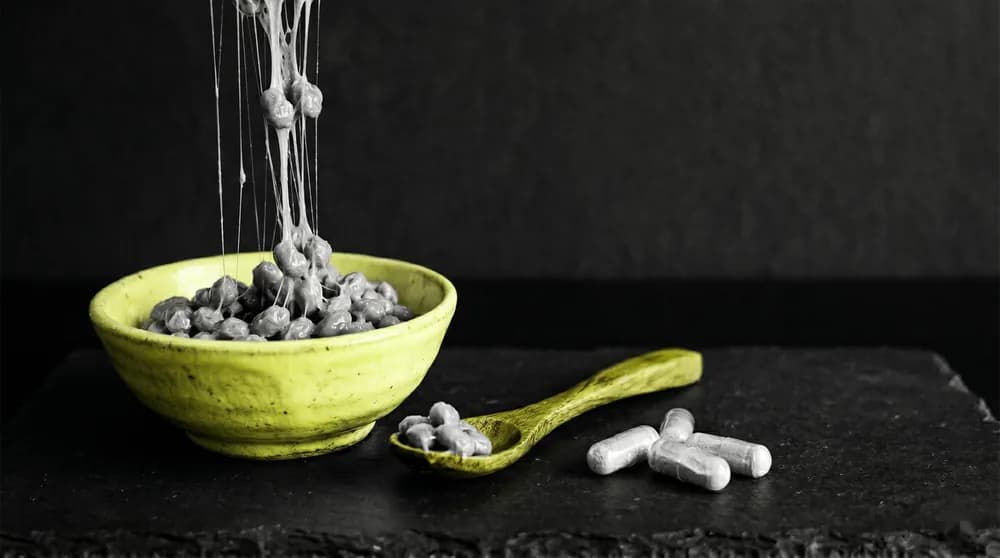
On social media, nattokinase has a fixed spot: an enzyme from fermented soybeans that supposedly clears clogged arteries, dissolves vascular plaque and, on the side, breaks down viral "spike proteins" — a natural blood thinner that rivals statins. Sounds too good to be true?
The honest answer: partly. One effect of nattokinase is genuinely well supported — but it isn't the one being marketed. Let's look at what the best studies show, not just the most spectacular ones.
Claim vs. evidence at a glance
| Claim | What the evidence shows | Verdict |
|---|---|---|
| Lowers blood pressure | RCT meta-analysis: modest reduction (~−3.5/−2.3 mmHg) | 🟡 moderate |
| Dissolves arterial plaque | Only one retrospective study without a true control; the best RCT is null | 🔴 weakly supported |
| Lowers cholesterol | RCT data mixed-to-unfavorable | 🔴 not supported |
| Breaks down viral "spike proteins" | Test tube only, no human studies | 🔴 unsupported |
| Acts fibrinolytically (cleaves fibrin) | Clearly shown in the lab | 🟢 established (in vitro) |
What nattokinase actually is
Natto is a traditional Japanese dish of soybeans fermented with the bacterium Bacillus subtilis var. natto — famous for its intense smell and sticky, stringy texture. In 1987, Japanese researcher Hiroyuki Sumi described that this fermentation produces an enzyme with strong fibrinolytic activity: nattokinase can directly cleave fibrin — the mesh protein that holds blood clots together — in the test tube.
This lab property is undisputed. The decisive question is a different one: how much of that happens in the living human?
What's really proven: blood pressure
Here's the honest bright spot. A meta-analysis of six randomized controlled trials found a modest but statistically significant blood-pressure reduction — on average about −3.5 mmHg systolic and −2.3 mmHg diastolic (meta-analysis 2024). A plausible mechanism is inhibition of the angiotensin-converting enzyme (ACE) — the same target as pharmaceutical ACE inhibitors, only much weaker.
That's not a miracle, but it's real. For someone with mildly elevated blood pressure, a reduction of this magnitude can matter as a complementary building block — not as a replacement for established therapy.
The plaque myth: a strong study beats a spectacular one
The viral claims rest almost entirely on one paper: a Chinese study of 1,062 participants (Chen et al. 2022). Over 12 months it reported breathtaking numbers for the high-dose group (10,800 FU/day): plaque regression in 66.5% of participants, cholesterol reduction in over 95%.
Sounds overwhelming — until you look at the study design:
Context: Chen 2022 was a retrospective observational study without a true control group. The "control" didn't take a placebo pill, just a lower dose of nattokinase. Such a design cannot prove cause and effect — selection effects, healthier accompanying habits and other biases aren't ruled out. Spectacular effect sizes are exactly what weak designs produce.
Against this stands the highest-quality evidence — and it shows the opposite: the NAPS trial (Hodis et al. 2021) was randomized, double-blind and placebo-controlled. 265 people took nattokinase or placebo for 3 years. The result: no difference in intima-media thickness (the ultrasound measure of arterial-wall thickening) or arterial stiffness.
Being fair: NAPS used 2,000 FU, a much lower dose than Chen's 10,800 FU — so a dose effect can't be entirely ruled out. But: the burden of proof lies with the extraordinary claim. An uncontrolled retrospective study is no substitute for a randomized one — and the only randomized plaque trial was negative.
Translated: that nattokinase dissolves existing arterial calcification is not proven in humans.
The cholesterol question
Here too the marketing doesn't deliver. In the RCT meta-analysis the lipid picture was mixed-to-unfavorable: lower doses actually raised total and LDL cholesterol and lowered protective HDL in trials; higher doses brought modest improvements at best. The "95% lower their cholesterol" figure from the retrospective study has no counterpart in the controlled data.
Fact check: spike proteins
In alternative-health media, the claim circulates that nattokinase breaks down viral spike proteins in the blood. The state of play: there are isolated in-vitro experiments (in the test tube) in which the enzyme degrades protein structures. Reliable clinical human studies are entirely absent. Inferring from the test tube to the living organism is precisely the leap serious science doesn't make. Healthy skepticism is warranted.
The vitamin K2 in natto
A valid point about the whole food: traditional natto is one of the richest natural sources of vitamin K2 (MK-7). And K2 has its own, better-supported role for the vessels — it helps steer calcium into bone rather than into artery walls, with evidence against vascular calcification (Schwalfenberg 2017).
Important: that's an effect of K2, not of nattokinase. Isolated nattokinase capsules usually contain no meaningful K2. If you want K2's vascular protection, targeted vitamin D3 + K2 serves you better than hoping an enzyme will do the job.
Safety: the most important section
Nattokinase is often sold as a "risk-free" natural blood thinner. That's dangerously dismissive, because the enzyme genuinely interferes with blood clotting.
Warning: Anyone taking pharmaceutical blood thinners (warfarin, apixaban/Eliquis, rivaroxaban/Xarelto or high-dose aspirin) or with a known clotting disorder must never use nattokinase without medical consultation. Dangerous accumulation with an increased risk of internal bleeding can result. The same applies before surgery and during pregnancy.
And fundamentally: nattokinase is not a substitute for a statin or any other proven cardiovascular therapy. Anyone at elevated risk belongs under medical care — not in a self-experiment.
Before you try it: measure and dose right
If you want to test nattokinase — say, for the blood-pressure effect — do it informed:
- FU, not milligrams. What matters is the enzyme activity in FU (fibrinolytic units), not the capsule's milligrams. Preventively, ~2,000 FU/day is common.
- Take on an empty stomach (~30–60 min before or 2 h after a meal), or the enzyme gets digested as a dietary protein.
- Check purity — ideally without unnecessary fillers; details on the nattokinase compound page.
- Know the right markers. For cardiovascular prevention what counts is mainly ApoB, once-in-a-lifetime Lp(a), LDL and blood pressure — see Biomarkers & Blood Tests. An enzyme doesn't replace diagnostics.
Bottom line
Nattokinase is a fascinating enzyme with a real but modest benefit — and a large marketing surplus.
- Proven: a modest blood-pressure reduction (🟡).
- Not proven: dissolving arterial plaque (the best RCT is null) and the cholesterol miracles (🔴).
- Unsupported: the spike-protein myth.
- Important: real bleeding risk with anticoagulants — not a "harmless" natural remedy and not a statin substitute.
If you want to address mildly elevated blood pressure as a complement, you can consider it — informed and medically cleared. If you're hoping for the viral promise of clean arteries, put your money into what demonstrably works: exercise, diet, not smoking, and the markers that truly count.
- [1]Chen et al. (2022): Effective management of atherosclerosis progress and hyperlipidemia with nattokinase — A clinical study with 1,062 participants (Frontiers in Cardiovascular Medicine, retrospective)
- [2]Hodis et al. (2021): Nattokinase Atherothrombotic Prevention Study (NAPS) — randomized, placebo-controlled trial (Clinical Hemorheology and Microcirculation)
- [3]Systematic Review & Meta-Analysis of randomized trials (2024): Nattokinase & cardiovascular risk factors
- [4]Sumi et al. (1987): First description of nattokinase as a fibrinolytic enzyme (Experientia)
- [5]Schwalfenberg (2017): Vitamins K1 and K2 & vascular calcification (J Nutr Metab)
- [6]PubMed search: Nattokinase & blood pressure (clinical trials)