Slow Skin Aging: What Actually Works — From Sunscreen to Collagen
80% of visible skin aging comes from the sun. The honest hierarchy of anti-aging levers — sunscreen, retinoids, collagen, red light — ranked by evidence, not by marketing.

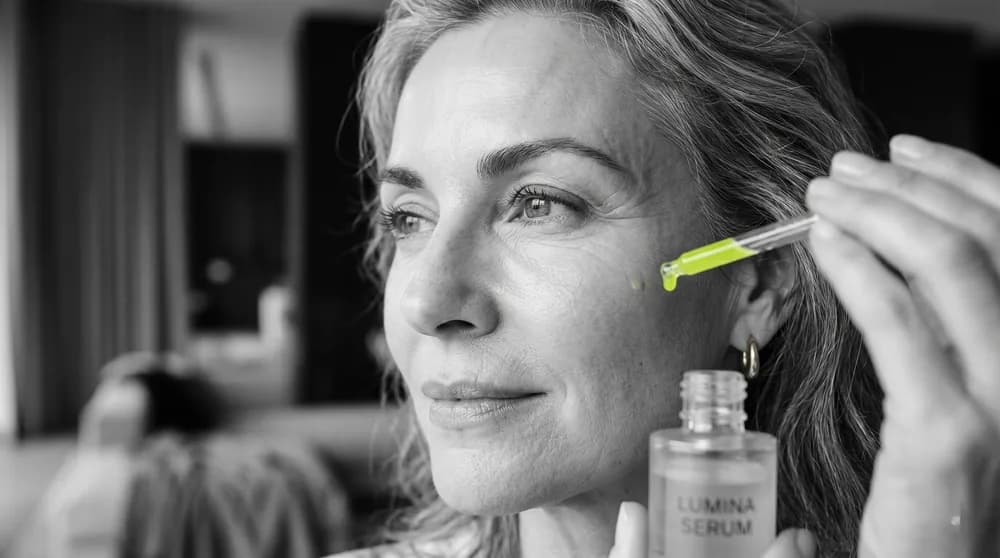
Skin is the largest organ — and the only one whose aging you watch in the mirror. The good news: skin aging is, to a surprising degree, not fate but environment. Roughly 80% of visible facial aging is due to UV radiation (photoaging), not the calendar. Which means the most effective levers are cheap and well supported — the expensive rest is fine-tuning. (Bryan Johnson reportedly turned back his "skin age" by years in his Blueprint protocol — using exactly this hierarchy.)
The honest order: you cannot out-supplement sun damage. Basics first (sun, no smoking, sleep, sugar), then topicals (retinoids), then supplements and devices. Reverse the order and you burn money.
The anti-aging hierarchy by evidence
| Lever | Effect | Evidence |
|---|---|---|
| Sun protection | Slows photoaging — by far the biggest lever | 🟢 strong (RCT) |
| No smoking / low sugar / sleep | Less collagen breakdown & glycation | 🟢 strong |
| Topical retinoids (tretinoin/retinol) | Collagen building, fine lines | 🟢 strong (RCT) |
| Topical vitamin C + niacinamide | Antioxidant, pigment, barrier | 🟡 moderate |
| Oral collagen peptides | Elasticity, hydration | 🟡 moderate |
| Oral astaxanthin, hyaluronic acid | UV resilience, hydration | 🟠 emerging |
| Red light / LED | Collagen, skin texture | 🟡 moderate |
| Lasers/RF (clinic) | Structure, pigment, lifting | 🟢 strong (but invasive) |
1. Sun protection — by far the biggest lever
It's unspectacular but true: daily sun protection is the single most effective anti-aging measure there is. In a randomized trial (Hughes et al. 2013), people using daily sunscreen showed no measurable increase in skin aging after 4.5 years — those without aged visibly further. UVA penetrates deep and destroys collagen and elastin.
Practical: mineral or chemical broad-spectrum protection (SPF 30+) on exposed days, plus shade/hat/clothing at high UV index. It's the foundation everything else builds on.
2. The internal basics: no smoking, sugar, sleep
- Smoking dramatically accelerates wrinkling (vascular and collagen damage).
- Sugar & glycation: with chronically high blood sugar, sugar molecules cross-link collagen and elastin (so-called AGEs) — skin loses firmness. Fewer fast carbs = less skin glycation.
- Sleep: deep sleep runs repair and collagen synthesis. Chronic sleep loss shows up in the face.
3. Topical retinoids — the gold standard on the skin
If one skincare product demonstrably reduces wrinkles and builds collagen, it's retinoids (prescription tretinoin or over-the-counter retinol). Numerous RCTs show improved skin structure and fine lines. Ramp up slowly (irritation), apply at night, use sunscreen in the morning.
4. From within: the supplements with real data
This is where our compound database pays off — the beauty supplements with the best evidence:
- Collagen peptides (2.5–10 g/day, with vitamin C): several RCTs show better elasticity and hydration. Caveat: many studies are industry-funded — real, but don't overrate.
- Astaxanthin: potent antioxidant, best supported for UV resilience and elasticity.
- Hyaluronic acid oral: moderate evidence for more skin hydration.
- Vitamin C: cofactor of collagen synthesis — relevant inside and out.
Context: supplements are the finishing touch, not the foundation. Without sun protection and a retinoid, you get little out of them.
5. Light & clinic: red light, lasers, RF
- Red-light/LED therapy: photobiomodulation stimulates collagen; studies show moderate improvements in fine lines and skin density. Needs patience + consistency. (More on the mechanism in the sunlight/infrared piece.)
- Lasers (1927/1550 nm), radiofrequency, microneedling: in the dermatology clinic the strongest levers for structure, pigment, and lifting — but invasive, expensive, and for specialist hands.
A realistic routine framework
| When | What |
|---|---|
| Morning | Cleanse → vitamin C → moisturize → sun protection |
| Evening | Cleanse → retinoid → moisturize |
| Daily, internal | Collagen + vitamin C, nutrient-dense diet, sleep |
| Optional | Red-light mask (3–5×/week), 1–2×/year in-clinic treatment |
Bottom line
Beautiful, slowly aging skin is less about expensive creams than consistent basics: sun protection every day, no smoking, sugar under control, sleep — plus a retinoid. On top of that, collagen, vitamin C, astaxanthin, and red light add a sensible extra. The order is everything: manage the sun first and you capture 80% of the effect — the rest is polish, not a substitute.
- [1]Hughes et al. (2013): Sunscreen & Photoaging — randomized trial, Annals of Internal Medicine
- [2]PubMed search: topical retinoids / tretinoin & photoaging (RCTs)
- [3]PubMed search: collagen peptides & skin elasticity (RCTs)
- [4]PubMed search: skin glycation / AGEs & skin aging
- [5]PubMed search: LED / red-light photobiomodulation & skin rejuvenation
- [6]Bryan Johnson — Blueprint (skin protocol & Visia measurement)