Creatine: The 5 Biggest Myths — and What the Science Says
Does creatine damage your kidneys? Make you bloat or cause hair loss? The 5 most stubborn creatine myths in an evidence-based fact-check — with ISSN sources.

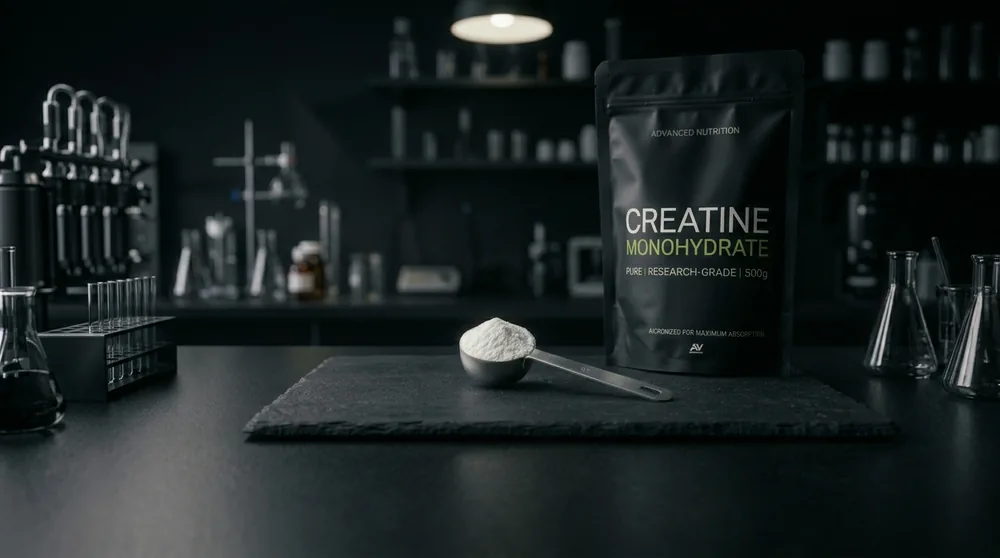
Creatine is one of the most researched supplements on the planet — first isolated back in 1832, today backed by hundreds of clinical trials. And yet hardly any other molecule lingers in such a fog of half-knowledge: it supposedly damages your kidneys, makes you bloat, is only for men, drives hair loss, and triggers muscle cramps.
In most cases the truth is the exact opposite. Its core job is simple: when cells spend their energy currency ATP (adenosine triphosphate), creatine helps recharge it in a flash — in muscle and brain alike. Here are the five biggest creatine myths, checked against the current evidence.
| Myth | Fact-check | Evidence |
|---|---|---|
| "Creatine damages the kidneys" | ❌ False in healthy people — it's a measurement artifact | 🟢 strong (RCTs, ISSN) |
| "Creatine bloats you / makes you fat" | ❌ The water sits inside the muscle cell, not under the skin | 🟢 strong |
| "It's only for men" | ❌ Women benefit broadly — including their bones | 🟡 moderate |
| "Creatine causes hair loss" | ❌ Not a single case of hair loss ever measured | 🟡 limited (1 study, never replicated) |
| "Creatine causes cramps" | ❌ If anything, the opposite | 🟢 strong |
Myth 1: Creatine damages your kidneys
By far the most widespread misconception — and it confuses even doctors. The reason isn't real harm but a false alarm when reading blood values.
When the body uses creatine, it produces creatinine as a natural by-product. That travels into the blood and is excreted by the kidneys. In a routine blood test, your doctor measures exactly this creatinine value to calculate your eGFR (estimated glomerular filtration rate — a measure of how well the kidneys filter).
When a healthy person takes creatine (or eats a lot of red meat), creatinine rises slightly. The eGFR formula then automatically reads that elevated value as "worse filtration." The result is a false positive: the kidney is working perfectly, it simply has more by-product to process. Decades of randomized controlled trials — summarized in the ISSN position stand — show that creatine has no harmful effect on kidney function in people with healthy kidneys.
Diagnostic tip: If you want to monitor kidney function cleanly while taking creatine, ask for a cystatin-C-based eGFR instead of the creatinine-based one. Cystatin C is unaffected by creatine intake and gives an undistorted picture.
Caveat: This all-clear applies to healthy kidneys. Anyone with existing kidney disease should clear supplementation with a physician first.
Myth 2: Creatine bloats you and makes you fat
Many people — women especially — avoid creatine for fear of sudden weight gain and a "bloated" look. Again, look inside the cell.
Creatine is osmotically active, so it binds water. What matters is where: not subcutaneously (under the skin, which would look puffy) but intracellularly — right inside the muscle cell. A muscle cell plumped with water is actually a desirable state: that cell swelling sends mechanical signals that stimulate protein synthesis (the building of new muscle proteins).
At a maintenance dose of 3–5 g per day (rather than the outdated 20 g loading phases), the initial water retention is far smaller — for many, barely noticeable. Long-term, creatine produces a measurable increase in lean body mass. That it also supports fat loss is hinted at by some analyses — but the evidence is weak and inconsistent, so don't count on it.
Myth 3: Creatine is only for men
The data say the opposite: women respond very robustly to creatine — and partly benefit beyond pure muscle effects.
Alongside gains in strength and performance, bone health is especially relevant. During the peri- and postmenopausal phase, when estrogen drops and the risk of bone loss climbs, creatine combined with resistance training can be protective: it dampens the activity of osteoclasts (bone-resorbing cells) and supplies osteoblasts (bone-building cells) with energy. Studies like Chilibeck et al. show a slowed decline in bone density over a year.
Context: The bone effect is promising but not equally strong across all studies — creatine slows the loss; it doesn't replace strength training or medical osteoporosis treatment. The bone and cognition studies cited here also used somewhat higher doses (~0.1 g/kg, i.e. ~8 g/day) than the usual maintenance dose.
Myth 4: Creatine causes hair loss
Anyone looking for a reason to avoid creatine quickly runs into warnings about hair loss online. This myth traces back to a single study in rugby players (van der Merwe et al., 2009).
There, players received very high doses during a loading phase. Afterward, levels of the hormone DHT (dihydrotestosterone — a testosterone by-product linked to the shrinking of hair follicles) rose measurably. What's almost always left out online:
- The study measured no parameter for actual hair loss or follicle thinning — only a hormone marker.
- No later study has reproduced that DHT rise or any effect on hair growth.
The ISSN position stand accordingly states: there is no scientific evidence that creatine causes hair loss. If you're already prone to androgenetic hair loss, the genuinely evidence-based levers are in our overview Hair loss: what actually works.
Myth 5: Creatine causes muscle cramps
The claim that creatine pulls water out of the body and thereby promotes cramps turns reality on its head.
As explained in Myth 2, creatine "super-hydrates" the muscle cell — it binds fluid inside the muscle. Yet one of the main triggers of cramps is precisely tissue dehydration. By raising the water content in the muscle, creatine works against cramps. Sports-medicine research even shows that athletes who supplement creatine suffer fewer cramps, heat exhaustion, and injuries — especially in hot environments — than their non-supplementing peers.
How to take creatine properly
No wizardry — and no expensive marketing required:
| Question | Answer |
|---|---|
| Form | Micronized monohydrate (e.g. Creapure®). Pricey "special forms" add nothing. |
| Dose | 3–5 g per day, ongoing. I personally take 10 g/day (higher doses are discussed for brain and bone) — but that's my own choice, not a standard. Everyone should weigh it for themselves, ideally with medical guidance. |
| Loading | Not necessary — it only speeds up saturation, it's not a must. |
| Timing | Any time. What matters is doing it daily and consistently. |
More detail, study counts, and sources on the compound page: Creatine Monohydrate. And for what creatine can do beyond muscle — brain, bone, aging — see the overview: Creatine for Brain, Bone & Longevity.
Bottom line
- Kidneys: Harmless in healthy people — the supposed "damage" is a measurement artifact. Use cystatin C to monitor.
- Bloating: The water sits inside the muscle cell and is desirable, not under the skin.
- Only for men: Wrong — women benefit broadly, especially for bones and through menopause.
- Hair loss: Not a single proven case; the myth hangs on one never-replicated study.
- Cramps: Protective rather than causative.
Bottom line: creatine is one of the few supplements with strong evidence, an excellent safety profile, and benefits that reach far beyond the muscle. Most of the reservations simply don't survive a fact-check.
- [1]Kreider et al. (2017): ISSN Position Stand on Creatine Supplementation — JISSN
- [2]Antonio et al. (2021): Common questions and misconceptions about creatine supplementation — JISSN
- [3]van der Merwe et al. (2009): Creatine loading and serum DHT in rugby players
- [4]Chilibeck et al. (2015): Creatine + resistance training and bone in postmenopausal women
- [5]Dolan et al. (2019): Beyond muscle — creatine for brain and bone health
- [6]Greenwood et al.: Creatine supplementation, cramping and injury in athletes