Hair Loss: What Actually Works — The Evidence-Based Ranking
Only a handful of treatments are proven against hereditary hair loss: finasteride, minoxidil, laser cap. What the studies say, what's a waste of money — and why starting early matters.

Hereditary hair loss (androgenetic alopecia) affects most men over a lifetime — and many women. The market is full of "hair vitamins," serums, and shampoos, the vast majority of which do nothing. The good news: a small handful of treatments are genuinely proven. Here's the honest ranking — and where your money gets burned.
Two truths up front: (1) Start early. Treatments preserve hair far better than they bring back what's gone. (2) The effective ones must be used continuously — stop, and the loss returns.
The mechanism in one sentence
With a genetic predisposition, the hormone DHT (dihydrotestosterone, from testosterone via 5-alpha-reductase) progressively shrinks hair follicles — they get thinner, shorter, until they give up. The proven therapies target exactly this: lower DHT or boost perfusion/the growth phase.
The evidence ranking
| Treatment | Effect | Evidence |
|---|---|---|
| Finasteride (Rx, oral) | Lowers DHT — most effective single agent | 🟢 strong — but side-effect debate |
| Minoxidil (topical/oral) | Prolongs growth phase, more perfusion | 🟢 strong |
| Red-light laser cap (LLLT) | Photobiomodulation of follicles | 🟡 moderate (FDA-cleared) |
| Ketoconazole shampoo | Mild anti-androgen, adjunct | 🟡 weak–moderate |
| Saw palmetto | Mild, natural DHT inhibitor | 🟠 weak |
| Biotin | Only useful in genuine deficiency | 🔴 overrated |
The three that actually work
Finasteride is the most effective single agent: it lowers DHT and halts loss in many, often with visible thickening. The catch is the side-effect debate (sexual dysfunction, mood, the rare post-finasteride syndrome) — prescription only, weigh benefit/risk individually with a physician.
Minoxidil (topical 5%, increasingly low-dose oral off-label) is the second mainstay — well supported, over-the-counter, working via perfusion and a prolonged growth phase. Often a temporary "shedding" phase at the start.
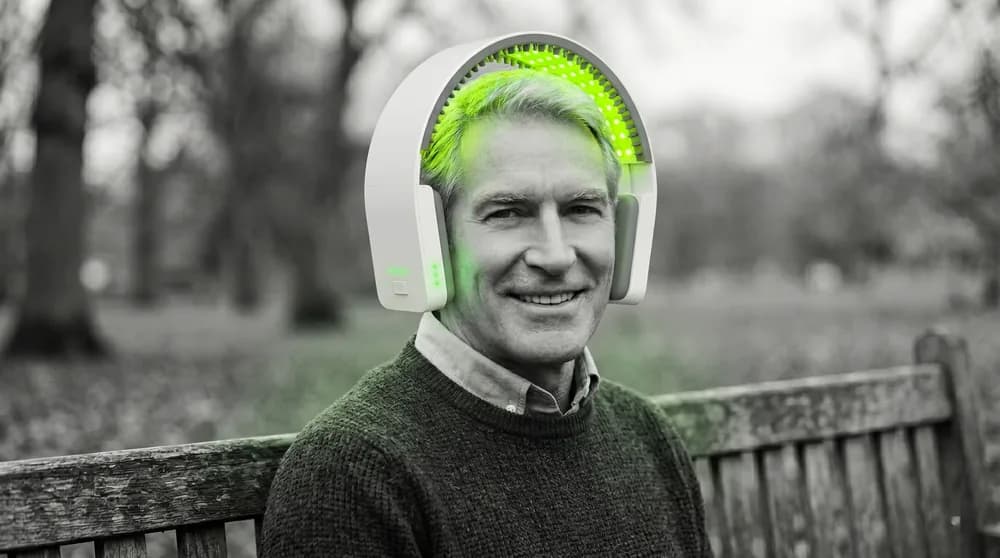
Red-light laser cap (LLLT, ~650 nm range): meta-analyses show a moderate increase in hair density — most likely in early/mild loss with consistent use. A complement rather than a replacement.
The proven stack: the strongest strategy is the combination — finasteride (DHT down) + minoxidil (growth up) ± laser cap work through different mechanisms and complement each other.
The honest example: Bryan Johnson
A telling case: Bryan Johnson is genetically predisposed to baldness and pushed back in his early 40s — with minoxidil (topical + low-dose oral) and a laser cap. He explicitly refuses finasteride because of its side-effect risks. It shows that even the "most measured person" makes a personal benefit-risk call here — one everyone has to make for themselves.
What does (almost) nothing
- "Hair vitamins" & biotin with normal status: no proven effect — biotin only helps in genuine deficiency and distorts lab tests.
- Saw palmetto: marketed as "natural finasteride," but only weakly supported for hair.
- Micronutrients (zinc, iron, vitamin D) only help if you're deficient — measure first.
Women & when to see a doctor
For women, topical minoxidil is first-line; finasteride is usually not used. Important: sudden, patchy, or diffuse hair loss often has other causes (iron deficiency, thyroid, stress, medications, autoimmune) — that needs medical evaluation, not self-treatment.
Bottom line
Against hereditary hair loss, only a small, clearly proven group works: minoxidil, finasteride (Rx), and LLLT — best combined, started early, and used continuously. The rest of the market is mostly hope in pill form. Stay realistic, act early, and weigh the prescription options with a doctor, and you get the maximum — everything else is money down the drain.
- [1]PubMed search: finasteride & androgenetic alopecia (RCT/meta)
- [2]PubMed search: minoxidil (topical/oral) & androgenetic alopecia
- [3]PubMed search: low-level laser therapy (LLLT) & hair growth (meta)
- [4]PubMed search: saw palmetto / Serenoa repens & hair loss
- [5]PubMed search: biotin & hair — deficiency vs supplementation
- [6]PubMed search: DHT, 5-alpha-reductase & hair follicle miniaturization
- [7]Bryan Johnson — Blueprint (hair protocol, refuses finasteride)