Urolithin A: Mitophagy, Muscle, and the Hype
What Urolithin A really does — from the Andreux and Liu human trials to mitophagy, muscle endurance, and why the 45% lifespan claim is worm data.

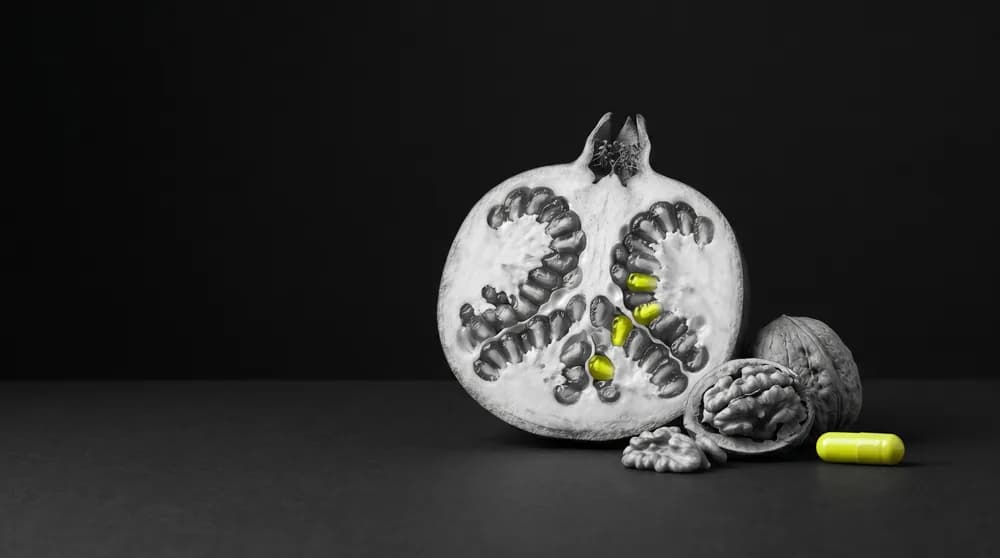
Few longevity ingredients have a cleaner mechanistic story than Urolithin A. It flips on mitophagy — the cell's recycling program for worn-out mitochondria — and the headlines write themselves: pomegranate compound makes worms live 45% longer, rebuilds aging muscle, rejuvenates the immune system. The mechanism is real, the human safety data are reassuring, and yet almost every viral claim about it is either softer than it sounds or borrowed from a different species. So what does Urolithin A actually do in people — and is it worth the price?
This is the honest version. We separate what the randomized human trials proved from what the marketing extrapolated.
The evidence at a glance
| Claim | What the evidence shows | Verdict |
|---|---|---|
| Induces mitophagy and improves mitochondrial biomarkers in humans | First-in-human trial (Andreux 2019): lower plasma acylcarnitines, upregulated muscle mitophagy/mitochondrial genes | 🟢 strong |
| Excellent safety up to 1000 mg/day for 4 months | Three RCTs, no serious adverse events; FDA GRAS no-questions notice | 🟢 strong |
| Improves muscle endurance in older adults without training | Liu 2022 RCT (N=66): endurance up, significant secondary outcome | 🟡 moderate |
| Increases muscle strength ~10-12% in middle-aged adults | Singh 2022 RCT (N=88), framed as proof-of-concept | 🟡 moderate |
| Lowers CRP and mitochondrial-stress biomarkers | Liu 2022 + Singh 2022: CRP, acylcarnitines, ceramides down | 🟡 moderate |
| Rejuvenates age-related immune fitness | One small 4-week manufacturer-linked trial (N=50) | 🟠 emerging |
| Extends lifespan ~45% | True only in C. elegans worms — no mammalian or human data | 🔴 false (for humans) |
| Improves aerobic performance / VO2 peak in people | Both pivotal RCTs missed their primary functional endpoints | 🔴 weak |
What it is — and why it isn't in your food
Urolithin A (UroA) is a postbiotic: it is not present in any food directly. Instead, specific gut bacteria — Gordonibacter, Ellagibacter and relatives — metabolize ellagitannins and ellagic acid from pomegranate, walnuts and berries into UroA. The compound you read about is what your microbiome makes, not what you eat.
Its best-characterized action is inducing mitophagy: the selective autophagic clearance of damaged or dysfunctional mitochondria. As we age, defective mitochondria accumulate, and the recycling machinery slows. In preclinical models, UroA restores mitochondrial quality and improves muscle function. In humans, oral UroA is bioavailable and shifts the molecular markers of mitochondrial health — it lowers plasma acylcarnitines and ceramides (signatures of mitochondrial stress) and upregulates mitophagy and mitochondrial gene expression in skeletal muscle.
That mechanistic backbone was first established in mice and worms (Ryu et al. 2016, Nature Medicine) and then confirmed at the biomarker level in people (Andreux et al. 2019, Nature Metabolism). On the mechanism, UroA earns its reputation.
What is actually proven in humans
Three randomized controlled trials anchor the human evidence. Read them for what they measured, not for the press release.
Biomarkers of mitochondrial health (🟢 strong). The first-in-human study (Andreux 2019) gave ~36 elderly, sedentary adults 500-1000 mg/day. The primary endpoint was safety — and it passed. The standout findings were molecular: lower plasma acylcarnitines and a skeletal-muscle gene-expression signature pointing toward improved mitochondrial and cellular health. No functional endpoint was tested. This is proof that oral UroA reaches the muscle and does something measurable.
Muscle endurance in older adults (🟡 moderate). Liu et al. 2022 (JAMA Network Open) ran an RCT in 66 adults aged 65-90 (mean ~71.7) at 1000 mg/day for 4 months. Muscle endurance — more contractions to fatigue in both hand and leg muscles — improved significantly versus placebo. Crucially, this was a secondary outcome, and the gain came without any exercise training.
Muscle strength in middle age (🟡 moderate). Singh et al. 2022 (Cell Reports Medicine) tested 88 middle-aged, overweight adults at 500 or 1000 mg/day for 4 months. Strength rose roughly +12% (500 mg) and +10% (1000 mg) versus baseline — statistically significant. The authors themselves frame this as a proof-of-concept study, not a definitive efficacy trial.
Lower inflammation and mitochondrial stress (🟡 moderate). Across Liu 2022 and Singh 2022, UroA reduced CRP (a marker of systemic inflammation) and the mitochondrial-stress biomarkers acylcarnitines and ceramides versus placebo at 4 months.
Immune fitness (🟠 emerging). The 2025 MitoImmune RCT (Nature Aging, N=50, ages 45-70, 1000 mg, 4 weeks) reported higher naive CD8+ T cells, increased T-cell mitochondrial biogenesis, and reduced exhaustion markers. It is a single, small, short trial run in collaboration with the manufacturer. Treat it as hypothesis-generating.
The overrated and the false
This is the part the supplement ads skip — and it is exactly where Biolazar earns its keep.
"Urolithin A makes you live 45% longer." The +45.4% figure is from C. elegans — roundworms — fed 50 µM from egg to death (Ryu 2016). There is no human lifespan data, and not even mammalian lifespan-extension data. Rodent studies showed improved muscle function, not longer life. Quoting the worm number as a human promise is the single most common distortion.
"It dramatically boosts physical performance." Here is the inconvenient truth: both pivotal human RCTs missed their pre-specified co-primary endpoints. Liu 2022 found no significant difference versus placebo in 6-minute walk distance (+60.8 m UroA vs +42.5 m placebo) or in maximal muscle ATP production. Singh 2022 found no significant improvement versus placebo in 6-minute walk or VO2 peak. The wins were all in secondary endpoints. That doesn't make UroA useless — it makes the "aerobic powerhouse" framing unsupported.
Caveat: A drug or supplement that misses its primary endpoint but hits secondaries is the textbook case for cautious optimism, not confident promotion. Secondary findings are hypothesis-confirming at best until a trial is designed to test them as the primary outcome.
"Just eat pomegranates and walnuts." This runs into the microbiome lottery. Only roughly 30-40% of people host the gut bacteria needed to convert ellagitannins into UroA — and some metabotype studies put the non- or low-producer fraction even higher (García-Villalba 2022). If you are a non-producer, dietary ellagitannins give you little to no UroA. That gap is the entire rationale for taking standardized UroA directly.
"The immune-rejuvenation study proves it reverses immune aging." It is one small (N=50), 4-week trial run with the manufacturer (Amazentis/Timeline). Cite the underlying Nature Aging trial, not the company press release, and read it as a signal to watch — not a settled result.
"The strongest known mitophagy inducer." UroA is a well-validated and notably potent natural, dietary-derived mitophagy inducer — the first-in-class natural compound in this space (Ryu 2016). But "strongest known inducer" overall is a marketing superlative: pharmacological mitophagy inducers exist, and there is no human head-to-head ranking that justifies an absolute claim.
Safety and interactions
Important: UroA has been well tolerated in every human RCT to date at 500-1000 mg/day for up to 4 months, with no serious adverse events attributable to it. The manufacturer's standardized UroA received an FDA GRAS "no questions" notice — a safety-for-food clearance, not an efficacy or drug approval.
Long-term safety beyond 4 months, and effects in younger, healthy people, are not established. Pregnancy, breastfeeding and children: not studied — avoid. There are no well-documented drug interactions, but because UroA modulates mitochondrial and autophagy pathways, anyone on chemotherapy or immune-modulating drugs should consult a physician first (an oncology immune-checkpoint trial is ongoing). As always, this is general information, not medical advice.
Dosing and what to actually buy
The doses behind every positive trial are 500-1000 mg/day — the amounts used in Andreux 2019, Liu 2022 and Singh 2022. There is no evidence supporting lower "microdoses."
The buying trap: pomegranate extracts do not reliably deliver UroA. Because of the producer-microbiome issue, an extract of ellagitannins only helps the ~30-40% of people who can convert it. Only synthetic, standardized UroA (the form used in the trials) delivers a known dose regardless of your gut flora. Check the label for a stated milligram amount of Urolithin A itself, not "pomegranate equivalent."
At effective doses, standardized UroA is one of the more expensive single supplements — a real consideration when budgeting a stack. Compare its evidence tier against cheaper, better-established mitochondrial options on our longevity supplements list, and see the full profile on the Urolithin A page. If your interest is mitochondrial support broadly, Coenzyme Q10 and PQQ sit in adjacent territory with their own evidence trade-offs.
Who is it actually for?
The cleanest case for UroA today is an older or sedentary adult worried about age-related muscle decline who wants a mechanism-backed, well-tolerated add-on and accepts that the gains are modest. The trial populations were exactly that: ages 65-90 (Liu) and middle-aged overweight adults (Singh).
If you are young, athletic and training hard, the evidence is thin — none of the trials studied you, and the strongest signals (endurance, biomarkers) appeared in people starting from a lower baseline. There is no reliable home test for your "producer" status, but the practical takeaway is the same: if you want a guaranteed dose, supplement the standardized form rather than relying on diet.
Bottom line
Urolithin A is a real, well-tolerated postbiotic mitophagy inducer with consistent human evidence for better mitochondrial biomarkers, modest muscle-endurance and strength gains, and lower CRP. But the headline "lifespan +45%" is worm data; both pivotal human trials missed their primary functional endpoints; the immune-rejuvenation finding rests on one small manufacturer-linked study; and most people cannot make meaningful amounts of it from food. That makes UroA a promising healthspan supplement for the right person — not a proven miracle. Buy the standardized form, dose it at 500-1000 mg, and keep your expectations calibrated to the secondary endpoints, not the marketing.
- [1]Ryu et al. (2016): Urolithin A induces mitophagy and prolongs lifespan in C. elegans and increases muscle function in rodents — Nature Medicine 22(8):879-888
- [2]Andreux et al. (2019): The mitophagy activator urolithin A is safe and induces a molecular signature of improved mitochondrial and cellular health in humans — Nature Metabolism
- [3]Liu et al. (2022): Effect of Urolithin A Supplementation on Muscle Endurance and Mitochondrial Health in Older Adults — JAMA Network Open 5(1):e2144279 (PMID 35050355)
- [4]Singh et al. (2022): Urolithin A improves muscle strength, exercise performance, and biomarkers of mitochondrial health in a randomized trial in middle-aged adults — Cell Reports Medicine 3(5):100633
- [5]MitoImmune RCT (2025): Effect of the mitophagy inducer urolithin A on age-related immune decline — Nature Aging (industry-collaborated)
- [6]García-Villalba et al. (2022): Urolithins — Comprehensive Update on Metabolism, Bioactivity, and Associated Gut Microbiota (metabotypes / producer fraction) — Mol Nutr Food Res