My Longevity Supplements: The Winners in My Stack
The longevity supplements I actually take every day — my top picks by evidence and value for money, from omega-3 and magnesium to the NMN bets.

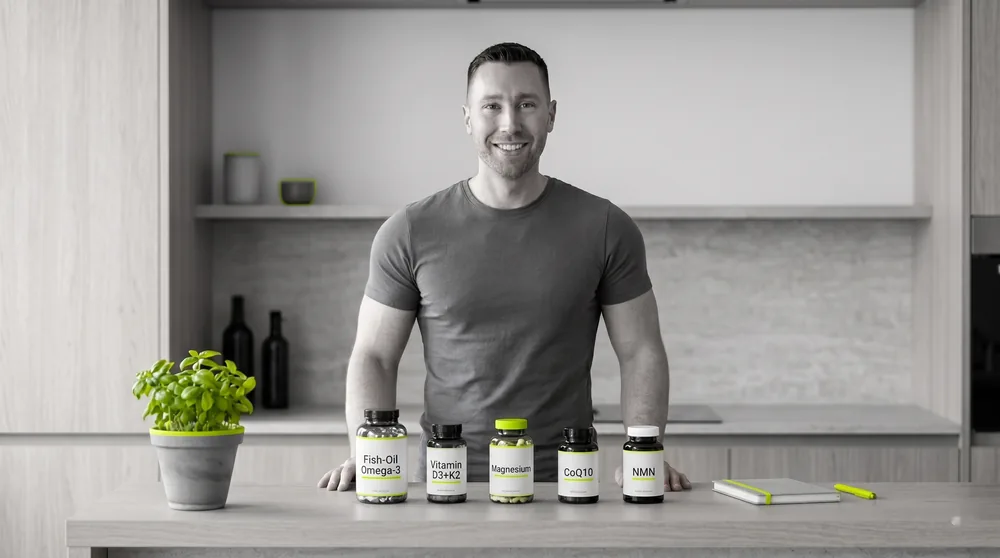
I've tried dozens of supplements over the past few years. Most got cut — either the evidence was thin, the price absurd, or I simply saw no point. What's left isn't a marketing stack; it's what I actually take.
One thing up front: "winners" here doesn't mean a lab test — it's my personal selection, filtered by two criteria: How good is the evidence? and What's the value for money? The objective, evidence-ranked overview lives in the sister article Longevity Supplements: The Honest List. This one gets personal.
Context: Supplements are the icing, not the cake. Sleep, exercise, diet and stress management beat any capsule. What follows complements a solid base — it doesn't replace it.
My stack at a glance
| Supplement | Why it's in my stack | Evidence | Value |
|---|---|---|---|
| Creatine monohydrate | Muscle, bone, brain — top evidence, cents per day | 🟢 strong | €€€€€ |
| Omega-3 | Heart, brain, inflammation — the best-supported foundation | 🟢 strong | €€€€€ |
| Vitamin D3 + K2 | Central-Europe standard; K2 steers calcium into bone, not arteries | 🟢 strong | €€€€€ |
| Magnesium glycinate | Evening, well tolerated, helps me wind down | 🟢 strong | €€€€ |
| Coenzyme Q10 | Mitochondrial support, declines with age | 🟡 moderate | €€€ |
| Selenium | Thyroid + glutathione system, year supply | 🟡 moderate | €€€€€ |
| Zinc | Immune system, hormones — year supply at a discount | 🟡 moderate | €€€€€ |
| Olive-oil polyphenols | Hydroxytyrosol, Mediterranean base in daily life | 🟡 moderate | €€€ |
| Turmeric | Anti-inflammatory, cheap | 🟡 moderate | €€€€ |
| Probiotics | Gut flora after antibiotics & in stressful phases | 🟡 moderate | €€€ |
| Berberine | Before carb-heavy meals for glucose control | 🟡 moderate | €€€€ |
| NMN(H) | My NAD⁺ bet — human evidence still young | 🟠 emerging | €€ |
| Spermidine | Autophagy support, currently testing | 🟠 emerging | €€€ |
| Rhodiola | Adaptogen for focus, cycled | 🟡 moderate | €€€€ |
(€€€€€ = excellent value for money · 🟢🟡🟠 = strength of evidence)
The non-negotiable three
If I had to cut everything down to three, these would stay — and it's no accident they're exactly the compounds with the best data. I wrote up the starting point separately: The Basics Stack: Omega-3, Vitamin D & Magnesium.
1. Omega-3. My foundation. The data on EPA/DHA and cardiovascular health is among the most robust in the supplement world (meta-analyses on omega-3 & all-cause mortality). I look for an IFOS certificate (purity, oxidation values) and take the capsules day-to-day, the liquid cod-liver oil when I want variety. Value: a year's supply costs less than two restaurant dinners.
2. Vitamin D3 + K2. In Central Europe, vitamin-D deficiency from October to March is the rule rather than the exception. The K2 (MK-7) combo is a must for me: K2 helps direct calcium into bone instead of arterial walls. But: I strongly recommend measuring your 25-OH-D level first instead of mega-dosing blindly — more is not better here.
3. Magnesium glycinate. The glycinate form, because it's well tolerated (no laxative effect like oxide) and the glycine itself is calming. Subjectively I settle down faster in the evening — that's my experience, not a study endpoint, but the moderate evidence on magnesium and sleep supports the direction.
The value-for-money star: creatine
If there's one supplement almost everyone should take, it's this: creatine monohydrate is among the best-researched compounds there are — good for muscle, bone, and increasingly the brain — and as a 1 kg powder it's by far the best value in my entire stack: the daily dose costs mere cents. I take 10 g per day (more than the muscle standard of 3–5 g, for the brain and bone effects discussed — my personal choice, not a general standard; weigh it with a doctor if unsure). More in Creatine beyond muscle and in the 5 biggest creatine myths.
The value-for-money winners
Here it's all about cost per day. I buy these three as a year's supply — the daily dose costs a fraction of a cent, and the compounds are essential enough to justify continuous use:
- Selenium (200 µg, 365 tablets): building block of the glutathione system and the thyroid. A year for the price of a movie ticket.
- Zinc (50 mg, 365 tablets): immune system and hormones. Caveat: with long-term high doses, keep an eye on copper status — zinc and copper compete for absorption.
- Lysine (2000 mg, 365 tablets): I don't take it daily but in phases for immune support — yet unbeatably cheap as a year supply.
The longevity bets
I take these with eyes open: intriguing mechanisms, but the evidence in humans is still young. I expect no guaranteed effect here — I'm placing a calculated bet.
- NMN(H): my NAD⁺ building block. That NMN/NR raise blood NAD⁺ is shown in humans — that it translates into measurably slower aging is not. I take the reduced form (NMNH) for better bioavailability but stay honest: this is a bet, not an established benefit.
- Spermidine: autophagy activation via food (wheat germ) is mechanistically elegant and epidemiologically interesting. Currently new to my testing.
- Berberine: here the evidence is already firmer — there are usable meta-analyses on glycemic control. I take it specifically before carb-heavy meals, not continuously.
What I deliberately leave out
Honesty matters — you will not find these "longevity classics" in my stack:
- Resveratrol: the original sirtuin hype largely failed to hold up in humans. Poor bioavailability, mixed trials. I skip it.
- High-dose isolated antioxidants (mega-doses of vitamin E, beta-carotene): can even harm in trials. I get my antioxidants from olive oil, green tea and colorful vegetables instead.
- Multivitamin "shotguns": I'd rather target what's demonstrably missing than throw 30 micronutrients at a guess.
Caveat: strictly speaking, my NMN(H) is a hype-adjacent bet too — the difference is that I label it as one instead of selling it as settled.
My selection rules (value, in detail)
What I look for when buying, in this order:
- Form over dose. Magnesium glycinate over oxide, ubiquinol CoQ10, reduced NMN. The right form beats a higher milligram count.
- Third-party testing / certificates. An IFOS seal for fish oil, otherwise lab-tested purity. For something you take daily, this isn't negotiable.
- Cents per daily dose, not price per jar. A year's supply looks expensive but is often cheapest per day.
- Vegan / fermentation where possible. For CoQ10, selenium and the like I go for fermented sources — usually cleaner and well tolerated.
Before you buy anything: measure
Supplementing on a hunch is expensive and sometimes counterproductive. These are the values I check before (and while) supplementing on purpose:
- 25-OH vitamin D — tells you whether and how much D3 you even need.
- Ferritin + transferrin saturation — iron status, especially on a plant-heavy diet.
- Vitamin B12 (holo-TC) — particularly relevant vegan/vegetarian.
- HOMA-IR (fasting insulin + glucose) — tells you whether berberine & co. even have a lever to pull.
The full marker overview is in the article Biomarkers & Blood Tests.
Bottom line
My stack isn't a recommendation, it's a snapshot — filtered by evidence and value, honestly split into proven foundation, value winners and calculated bets.
- Foundation: Creatine monohydrate, Omega-3, Vitamin D3+K2, Magnesium glycinate — well supported, cheap, non-negotiable for me.
- Value winners: Selenium, Zinc, Lysine as a year supply.
- Bets: NMN(H), Spermidine — with eyes open.
The full products with brands and doses are in my stack. And remember: no capsule replaces a good night's sleep.
- [1]PubMed search: Omega-3 & all-cause mortality (meta-analyses)
- [2]PubMed search: Vitamin D supplementation & mortality (meta-analyses)
- [3]PubMed search: Magnesium supplementation — sleep & metabolism
- [4]PubMed search: Berberine & glycemic control (meta-analyses)
- [5]PubMed search: NMN / NR — NAD⁺ increase in humans (clinical trials)
- [6]PubMed search: Spermidine & autophagy / longevity
- [7]EFSA Health Claim: Olive oil polyphenols (hydroxytyrosol) & protection of blood lipids from oxidative stress